
Nearly 49% of martech tools are underutilised across marketing teams, meaning most organisations are paying for capability they never activate. For luxury brands and purpose-driven businesses, that gap is not just wasteful. It is a competitive liability. This guide cuts through the noise to clarify what marketing SaaS platforms actually offer, how to compare leading solutions, and which methodologies turn software investment into measurable revenue. Whether you are evaluating your first integrated stack or auditing an existing one, the frameworks here will help you make sharper decisions and extract genuine ROI.
Table of Contents
- What is SaaS for marketing?
- Core SaaS platforms: Marketplace overview
- Key marketing methodologies enabled by SaaS
- Choosing SaaS for your marketing: Decision factors
- Getting value: Best practices for SaaS marketing success
- Level up your marketing results with tailored SaaS strategies
- Frequently asked questions
Key Takeaways
| Point | Details |
|---|---|
| Define your priorities | Clarify what you need from SaaS—automation, AI, attribution, or all three—to ensure the best fit for your marketing. |
| Match platform to strategy | Choose SaaS solutions that align with your brand’s workflows and audience, avoiding unnecessary complexity. |
| Exploit full-funnel tools | Use SaaS platforms to synchronise content, paid, SEO, and ABM for superior ROI. |
| Integration is critical | Connect your SaaS tools with CRM and analytics to unlock clean data and measurable results. |
| Continuous review drives value | Audit usage, performance, and new features regularly to keep your stack efficient and effective. |
What is SaaS for marketing?
SaaS stands for Software as a Service. In a marketing context, it refers to cloud-based platforms that deliver tools for automation, analytics, customer relationship management, and campaign execution without requiring on-premise installation or heavy IT infrastructure.
There are three broad categories worth understanding:
- All-in-one platforms (such as HubSpot) bundle CRM, email, automation, and reporting into a single interface
- Specialised tools (such as Klaviyo or Drip) focus on specific functions like e-commerce email or revenue attribution
- Enterprise solutions (such as Salesforce and Marketo) serve complex, multi-market organisations with deep customisation needs
Key features across these categories include event-driven workflows, revenue attribution, and AI personalisation. A CRM (Customer Relationship Management system) stores and manages contact data. Revenue attribution tracks which marketing touchpoints actually drive sales. Workflows are automated sequences triggered by user behaviour.
For luxury and purpose-driven brands, SaaS matters because it delivers speed, scale, and insight simultaneously. You can personalise at volume without sacrificing brand integrity. You can track performance without guesswork. Understanding B2B SaaS digital marketing principles is the foundation for making these tools work at a strategic level.
Core SaaS platforms: Marketplace overview
The platform landscape is broad, but the leading solutions each serve distinct needs. Here is a structured comparison to help you match toolsets to your brand profile.
| Platform | Best for | Key strength | Relative cost |
|---|---|---|---|
| HubSpot | SMBs and growing teams | All-in-one CRM and automation | Starter from $18/mo |
| Klaviyo | E-commerce brands | Email and SMS segmentation | Usage-based pricing |
| Drip | Attribution-focused teams | Revenue tracking and workflows | Mid-range |
| Marketo | Enterprise marketers | Advanced campaign orchestration | Premium |
| Salesforce Marketing Cloud | Large multi-market brands | Deep CRM integration | Enterprise tier |
HubSpot is rated 4.3/5 for SMBs, Klaviyo leads for e-commerce, and Marketo and Salesforce dominate enterprise use cases. HubSpot Starter begins at $18 per month, with SMB implementation typically taking 14 to 30 days and enterprise rollouts requiring 90 to 180 days.
When deciding between all-in-one and specialist tools, consider the following indicators:
- Choose all-in-one if your team needs a unified view of contacts, campaigns, and reporting in one place
- Choose specialist tools if you have a specific high-volume function (e.g., e-commerce email) that demands depth over breadth
- Choose enterprise platforms if you operate across multiple markets, brands, or complex data environments
For luxury brands, the ability to handle brand nuance and maintain data governance often points toward enterprise or carefully configured mid-tier solutions. Reviewing your SaaS marketing analytics reporting capability is a smart first step before committing to any platform. A well-structured data-driven marketing plan will also clarify which platform features you actually need versus which ones simply look impressive in a demo.
Key marketing methodologies enabled by SaaS
With the platform landscape in view, it is vital to understand the methodologies these tools empower, turning software investments into effective campaigns.
- AI-powered segmentation and personalisation. Modern SaaS platforms analyse behavioural data to segment audiences dynamically and serve personalised content at scale. This is particularly powerful for luxury brands where relevance and timing are everything.
- Lifecycle and event-driven campaigns. Triggers based on user actions (a trial sign-up, a page visit, a purchase) allow you to respond in real time. This keeps your brand present without feeling intrusive.
- A/B testing and lead scoring. Data-driven testing removes opinion from campaign decisions. Lead scoring prioritises your highest-value prospects automatically, so your team focuses effort where it counts.
- ROI attribution modelling. Single-touch attribution credits one touchpoint for a conversion. Multi-touch attribution distributes credit across the full journey. Multi-touch attribution is a differentiator for brands running complex, full-funnel campaigns across SEO, paid media, content, and account-based marketing.
“AI delivers a 22% ROI boost when integrated with unified data, not when deployed in isolation.”
This distinction matters. AI tools layered onto fragmented data produce noise. AI tools connected to a clean, unified CRM and customer data platform produce insight.

Pro Tip: Before activating any AI feature, audit your data sources. If your CRM, analytics platform, and paid media accounts are not sharing data, your AI outputs will reflect that fragmentation. Explore the SaaS content marketing benefits of aligning content strategy with these automated workflows, and consider how to optimise your SaaS marketing workflow before scaling any campaign.
Choosing SaaS for your marketing: Decision factors
Understanding methodologies helps, but choosing the right SaaS means matching those needs precisely to capabilities and brand objectives.
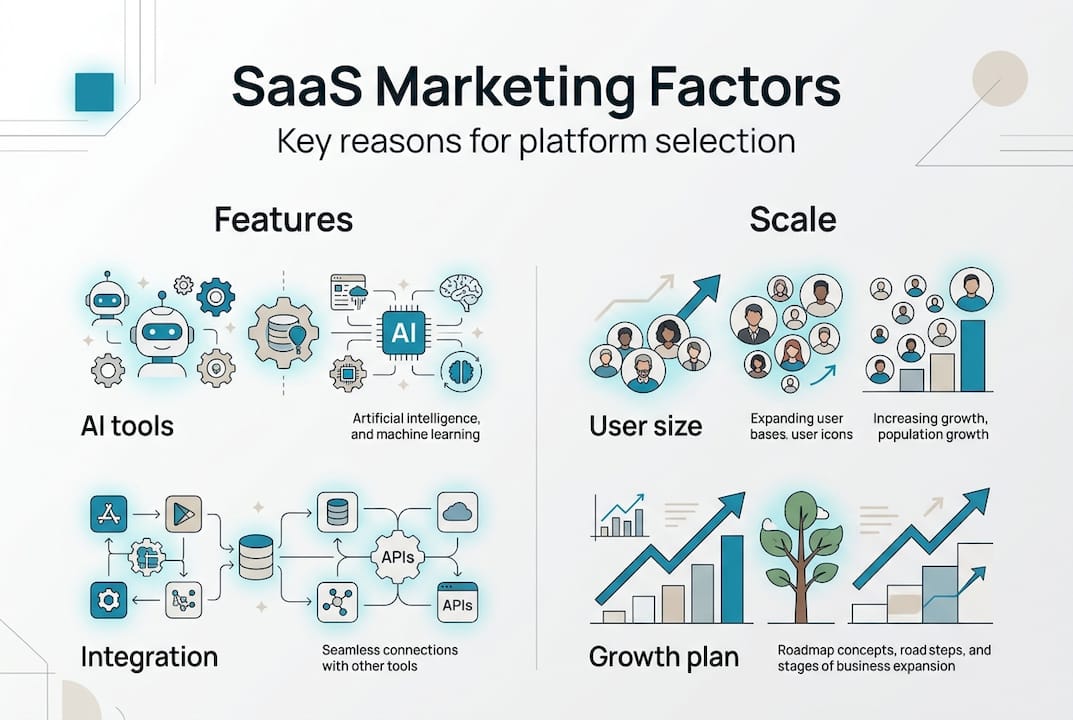
Use this checklist when evaluating any platform:
- CRM and data integration. Does it connect natively with your existing customer data? Forced workarounds create reporting gaps.
- Workflow complexity. Can it handle the trigger logic your campaigns require, or will you hit limits quickly?
- AI capability. Is AI a core feature or a bolt-on? Core AI integrations perform significantly better.
- Reporting sophistication. Does it offer multi-touch attribution, custom dashboards, and board-ready reporting?
- Scalability. Will it grow with your brand without requiring a full platform migration in 18 months?
Here is a quick reference for support and cost expectations:
| Platform | Support tier | Implementation time | Cost bracket |
|---|---|---|---|
| HubSpot | Standard to premium | 14 to 30 days | Low to mid |
| Klaviyo | Self-serve to managed | 7 to 21 days | Low to mid |
| Marketo | Dedicated CSM | 60 to 120 days | High |
| Salesforce | White-glove available | 90 to 180 days | Enterprise |
For luxury and purpose-driven brands, right-sized platforms outperform overbuilt ones. Choosing a platform with more features than your team can activate creates cost without return.
Pro Tip: Avoid platform sprawl. Start with the core capabilities your strategy demands. Scale up only when ROI justifies the additional investment. Mapping your SaaS customer journey data will reveal where the real gaps are. Strong B2B SaaS lead generation also depends on having clean, integrated data from the outset.
Getting value: Best practices for SaaS marketing success
Once the right SaaS is selected, extracting maximum value depends on implementation discipline and ongoing management.
- Audit your existing stack first. Identify duplicates, underutilised licences, and tools that overlap in function. Consolidation often improves performance before you add anything new.
- Set up integrations from day one. Connect your CRM, analytics platform, paid media accounts, and content tools immediately. Native CRM and unified reporting drive measurably superior results compared to siloed setups.
- Invest in staff onboarding. A platform is only as effective as the team using it. Vendor-led training, internal champions, and documented workflows all reduce the time to value.
- Run pilot A/B tests early. Quick wins from early testing build internal confidence and provide data to justify scaling budgets.
- Review performance regularly. Monthly usage and adoption reviews at CMO or board level keep the investment accountable. Track not just outputs (emails sent, leads generated) but outcomes (pipeline influenced, revenue attributed).
The most common pitfall we see is teams that focus on features rather than outcomes. A sophisticated automation sequence that does not connect to a revenue goal is just activity, not performance.
Pro Tip: Set a 90-day review milestone after any new SaaS deployment. Measure adoption rates, integration health, and at least one revenue-linked KPI. If the numbers are not moving, the issue is usually data quality or workflow design, not the platform itself. Explore proven approaches to boost SaaS conversions and build the kind of customer trust in SaaS that sustains long-term growth.
Level up your marketing results with tailored SaaS strategies
If you are ready to take your marketing SaaS performance to the next tier, expert support can accelerate results significantly. At Media House Agency, we work with luxury brands, destination businesses, and purpose-driven scale-ups to design, integrate, and optimise marketing SaaS stacks that perform. Our work spans workflow architecture, CRM and data integration, ROI attribution modelling, and data-driven storytelling that converts attention into revenue. We do not sell platforms. We engineer the strategy around them. Explore our advanced marketing tips for immediate tactical gains, build a sharper data-driven marketing plan, or review our SaaS conversion strategies to see where your funnel can perform harder.
Frequently asked questions
What are the benefits of SaaS for marketing teams?
AI personalisation and workflow automation drive measurable ROI improvements for SaaS-enabled marketing teams. Scalable platforms also reduce manual effort and improve reporting accuracy across the full funnel.
How do luxury brands use SaaS differently in marketing?
Luxury brands require white-glove support, native integrations, and deep attribution to maintain brand standards while scaling. Advanced segmentation and data privacy controls are also non-negotiable at this level.
What is the typical implementation time for marketing SaaS?
SMBs can deploy in 14 to 30 days, while enterprise implementations typically require three to six months depending on integration complexity and data migration requirements.
Is AI-driven marketing SaaS worth the investment?
Yes. Integrating AI with unified data can increase marketing ROI by 22%, making it one of the highest-return investments available to modern marketing teams.