
TL;DR:
- Content strategy is essential for differentiation and growth in the competitive B2B SaaS market.
- Successful SaaS content requires audience insights, clear goals, and consistent execution across multiple formats.
- Ongoing measurement and adaptation are vital to sustain growth and avoid strategy stagnation.
Standing out in the B2B SaaS market is harder than ever. With thousands of platforms competing for the same buyers, differentiation cannot rest on product features alone. Content strategy is the lever that separates brands that grow from those that stagnate. Done well, it builds credibility, attracts qualified leads, and compounds authority over time. This guide breaks down the foundational pillars, the preparation steps, and the execution process you need to build a content strategy that delivers real, measurable results. No fluff, no guesswork.
Table of Contents
- Understanding the pillars of B2B SaaS content strategy
- Preparation: Setting up your B2B SaaS content strategy
- Executing your strategy: Actionable steps for SaaS leaders
- Measuring success and refining your SaaS content efforts
- Why most B2B SaaS content strategies stall—and how to stay ahead
- Take your SaaS content strategy further with expert support
- Frequently asked questions
Key Takeaways
| Point | Details |
|---|---|
| Strategy foundations | Clarify your goals, audience, and brand positioning before any content creation begins. |
| Preparation tools | Audit assets, select essential tools, and map customer needs to create an agile plan. |
| Execution steps | Follow a repeatable workflow for creation, distribution, and optimisation to maximise impact. |
| Measure and refine | Regularly track results and adapt your strategy based on hard data and rapid learning. |
| Continuous innovation | Break through stagnation with customer-centric stories and new content experiments as your business grows. |
Understanding the pillars of B2B SaaS content strategy
A strong content strategy is not a content calendar. It is a structured system that connects your audience’s needs to your business goals. Before you publish a single word, you need to understand what that system is built on.
Content marketing is effective for SaaS brands seeking to boost ROI and build trust. But effectiveness depends entirely on how well you understand the pillars beneath it.
The core content types for B2B SaaS include:
- Blogs and long-form articles for organic search visibility and thought leadership
- Whitepapers and research reports to establish authority and capture leads
- Webinars and video content for engagement and product demonstration
- Case studies to build trust and validate claims with real outcomes
- Email sequences to nurture prospects through longer B2B sales cycles
Each format serves a different purpose at a different stage of the buyer journey. Mixing them strategically is what creates momentum.
Audience definition is non-negotiable. Using buyer personas gives your content direction. Without them, you are writing for everyone and reaching no one. In B2B SaaS, personas need to reflect real decision-making dynamics, including the economic buyer, the technical evaluator, and the end user.
Brand positioning matters just as much. In purpose-driven sectors, your content must communicate not just what you do, but why it matters. Thought leadership content, such as opinion pieces and industry commentary, is one of the most powerful ways to own a category. Look at B2B branding examples that have succeeded in competitive markets and you will notice a consistent voice and a clear point of view.
Goal-setting ties everything together. Are you building brand awareness, generating marketing qualified leads, or improving retention? Each goal requires different content, different channels, and different metrics. Define your targets before you create anything.
Pro Tip: Set one primary goal per content campaign. Trying to achieve awareness, leads, and retention simultaneously with a single piece dilutes impact and makes measurement nearly impossible.
Preparation: Setting up your B2B SaaS content strategy
Preparation is where most SaaS teams cut corners, and it shows. Skipping this phase leads to inconsistent output, wasted budget, and content that never gains traction.

Data-driven planning is key to SaaS marketing growth. That starts with auditing what you already have.
Your content audit should identify:
- Which existing pieces drive traffic, leads, or engagement
- Where content gaps exist across the buyer journey
- Which topics are underserved by competitors
- What formats your audience actually consumes
Once you know your gaps, you can map topics to specific pain points. Optimising the SaaS customer journey requires understanding exactly where prospects drop off and what content could re-engage them at each stage.
Preparation requirements table:
| Requirement | Purpose | Recommended tool |
|---|---|---|
| Content audit | Identify gaps and top performers | Screaming Frog, Ahrefs |
| Buyer persona documentation | Align content to real audience needs | HubSpot, Notion |
| SMART goal framework | Define measurable content objectives | Spreadsheet or OKR tool |
| Content management system | Organise and publish efficiently | WordPress, Contentful |
| Analytics platform | Track performance and attribution | Google Analytics 4, Databox |
| Syndication tools | Extend content reach beyond owned channels | Outbrain, Taboola |
SMART goals for content mean being specific about numbers. Instead of “increase blog traffic,” set a target such as “grow organic blog sessions by 30% within 90 days.” This creates accountability and makes it easier to course-correct.
Building effective personas at this stage means interviewing real customers, not just guessing. Ask about their daily frustrations, the information sources they trust, and the questions they had before purchasing your product.
Pro Tip: Before selecting any tool, map your workflow first. Tools should support your process, not define it. A simple spreadsheet used consistently beats an expensive platform used poorly.
If you want structured guidance through this phase, content strategy support is available for SaaS leaders who need to move faster without sacrificing rigour.
Executing your strategy: Actionable steps for SaaS leaders
Execution is where strategy becomes revenue. The challenge is maintaining consistency while adapting to what the data tells you. Here is a practical process that works.
Step-by-step execution process:
- Prioritise content by funnel stage. Map each content type to awareness, consideration, or decision. Blogs and social content build awareness. Case studies and webinars support consideration. Demos and ROI calculators close decisions.
- Create a content brief for every piece. Define the audience, goal, keyword focus, format, and call to action before writing begins. This eliminates ambiguity and speeds up review cycles.
- Build a publishing calendar. Frequency matters less than consistency. Two high-quality pieces per month outperform eight mediocre ones.
- Distribute across owned, earned, and paid channels. Owned includes your blog and email list. Earned includes press and backlinks. Paid amplifies what is already working. Content syndication methods extend your reach to audiences you have not yet built.
- Align sales, product, and marketing. Sales teams know the objections. Product teams know the differentiators. Marketing teams know the channels. Unified messaging requires all three working from the same brief.
- Automate where it makes sense. Email nurture sequences, social scheduling, and lead scoring can all be automated. This frees your team to focus on strategy and creative.
Lead generation is a core function of a SaaS content strategy, and it requires intentional design at every step.
Content channel comparison:
| Channel | Best for | Typical lead quality |
|---|---|---|
| Organic search | Long-term awareness and inbound leads | High |
| Email marketing | Nurturing and retention | Very high |
| Paid social | Targeted reach and retargeting | Medium |
| Webinars | Engagement and qualified pipeline | High |
| PPC | Intent-driven demand capture | High |
Understanding digital marketing for SaaS at a channel level helps you allocate budget where it will compound. And if you are considering paid amplification, understanding using PPC effectively ensures your spend converts rather than evaporates.
Pro Tip: Repurpose every high-performing piece. A webinar becomes a blog post. A blog post becomes an email sequence. An email sequence becomes a lead magnet. One idea, multiple touchpoints.
Measuring success and refining your SaaS content efforts
Execution without measurement is guesswork. Sustainable growth comes from knowing what works, cutting what does not, and doubling down on what does.
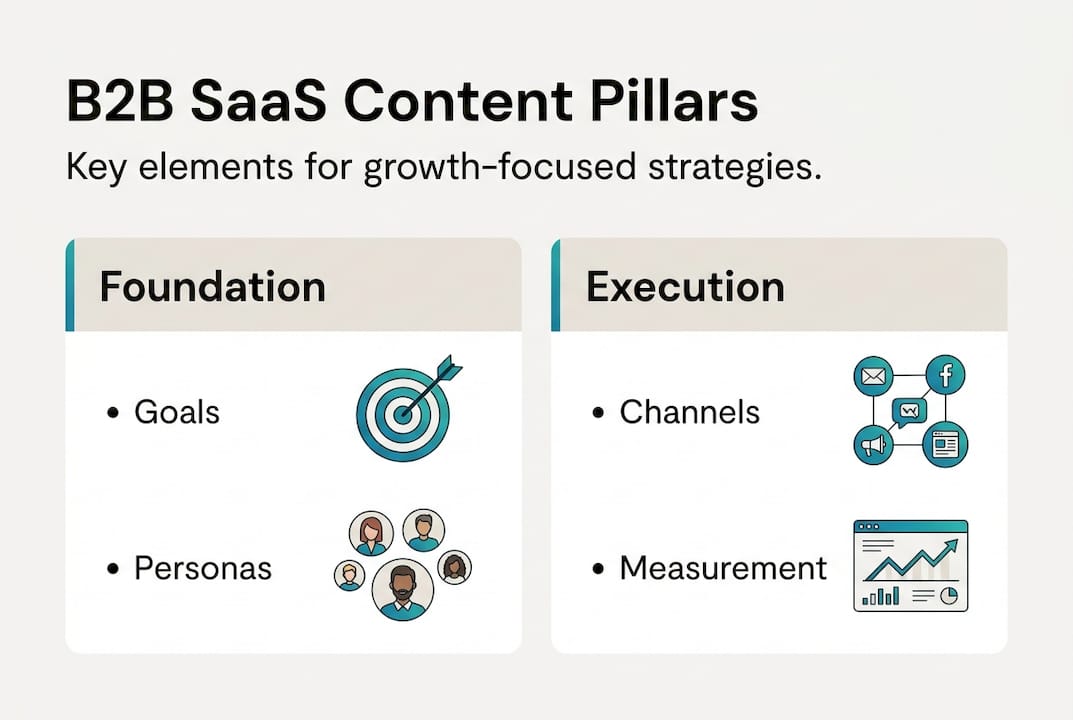
Branding and content strategy are iterative processes that require ongoing measurement. That means building a rhythm of review into your workflow from day one.
Key metrics to track:
- Conversions from content touchpoints to trial, demo, or purchase
- Marketing qualified leads generated per content channel
- Engagement rates including time on page, scroll depth, and return visits
- Organic reach and keyword ranking movement
- Revenue attribution tied to specific content assets
Attribution is the hardest part. Most B2B SaaS buyers interact with six to eight pieces of content before converting. Use multi-touch attribution models to understand which content is genuinely influencing decisions, not just getting the last click.
Schedule a monthly content review. Look at what moved the metrics and what did not. Adjust your content mix, your distribution, and your messaging based on evidence, not instinct.
“The brands that win in content are not the ones who publish the most. They are the ones who learn the fastest.”
Common pitfalls to avoid:
- Misaligned KPIs that measure vanity metrics instead of pipeline impact
- Stagnating formats when your audience has moved on to new channels
- Ignoring customer feedback that signals what content is actually needed
- Treating content as a one-off campaign rather than an ongoing system
Look at successful SaaS branding case studies and you will find that the common thread is adaptability. The strategy that worked in year one rarely looks the same in year two.
Pro Tip: Set a quarterly “content kill” review. Identify pieces that have received minimal traffic or engagement over 90 days and either update them with fresh data or redirect their URLs to stronger pages.
Why most B2B SaaS content strategies stall—and how to stay ahead
Here is what we see repeatedly. SaaS teams build a solid strategy, launch with energy, and then plateau around month four or five. The content keeps going out, but the results flatten. The usual response is to produce more. That rarely fixes it.
The real problem is almost always one of two things. Either the content has become too product-centric, talking about features rather than outcomes, or the team has started imitating competitors rather than leading the conversation. Both are slow-motion traps.
The brands that break through plateaus do something different. They obsess over the customer, not the product. They ask what their audience is genuinely struggling with right now, not six months ago. And they run micro-experiments. An unconventional topic, a new format, a contrarian point of view. These small bets often outperform the “safe” content that fills most editorial calendars.
Cutting-edge marketing is not about chasing trends. It is about staying close enough to your audience that you can anticipate their next question before they ask it. That is the real competitive edge.
Take your SaaS content strategy further with expert support
Building a content strategy that consistently drives growth is not a one-person job. It requires strategic clarity, creative execution, and rigorous measurement working together. That is exactly what we do at Media House Agency.
We work with B2B SaaS founders and marketing leaders to build SaaS marketing strategies that convert attention into authority and content into pipeline. Whether you need a full strategy build or sharper execution on what you already have, our team brings the precision and experience to accelerate results.
Explore our advanced SaaS marketing tips or start with a structured approach to building SaaS marketing plans that are grounded in data and built to scale.
Frequently asked questions
What is a B2B SaaS content strategy?
It is a structured approach to planning, creating, and distributing content that drives business goals for SaaS companies selling to other businesses. Content marketing is effective for SaaS brands seeking to boost ROI and build trust when applied with clear intent.
How do you measure if a SaaS content strategy is working?
Track conversions, lead quality, engagement rates, and revenue attribution to evaluate true content performance. Branding and content strategy require ongoing measurement to remain effective over time.
How important are buyer personas for SaaS content planning?
Buyer personas are critical because they ensure your content aligns with the real needs and motivations of your B2B audience. Defining buyer personas is foundational to effective content strategies at every stage.
Which content formats work best for SaaS lead generation?
Case studies, webinars, and whitepapers consistently drive qualified B2B leads and build trust. Lead generation is a core function of any well-designed SaaS content strategy.
What tools help manage a SaaS content strategy?
A strong toolkit includes a content management system, marketing automation, analytics, and content syndication platforms. Data-driven planning depends on having the right infrastructure in place from the start.
Recommended
- Optimise your B2B SaaS customer journey: data strategies 2026
- What is B2B content syndication: SaaS marketing guide
- Why use content marketing: key benefits for SaaS brands in 2026
- How to boost SaaS conversions: a comprehensive 2026 guide
- Så driver SaaS tillväxt: strategier och trender 2026 | Growth Nordic