
TL;DR:
- Scaling requires data-driven foundations, clear ICP, and robust customer success before expansion.
- A segmented go-to-market strategy focusing on verticals and aligned channels drives scalable revenue.
- Operational discipline and avoiding premature scaling are key to sustainable SaaS growth.
Product-market fit feels like the finish line. It isn’t. For most B2B SaaS founders, it’s where the real challenge begins. After early traction, growth stalls, churn creeps up, and the tactics that got you to £1M ARR simply won’t get you to £10M. Scaling requires a fundamentally different operating model, one built on data, repeatable processes, and ruthless prioritisation. This guide walks you through the exact framework we use with high-growth SaaS clients: from foundational readiness to go-to-market execution, demand generation, and operational discipline. Each section delivers actionable steps you can implement immediately.
Table of Contents
- Laying the groundwork: what you need in place before scaling
- Designing a scalable go-to-market strategy
- Building scalable, data-driven marketing and demand generation
- Operational frameworks: ensuring growth is sustainable
- Common scaling pitfalls and how to avoid them
- A fresh look: why scaling SaaS is more about discipline than speed
- Ready to scale your SaaS business? Take the next step
- Frequently asked questions
Key Takeaways
| Point | Details |
|---|---|
| Foundation first | Solidify product-market fit, data infrastructure, and team alignment before scaling. |
| Segment and focus | Target high-value segments with tailored go-to-market strategies and campaigns. |
| Use data-driven marketing | Implement content marketing, paid channels, and analytics to drive and optimise growth. |
| Operational discipline | Rely on frameworks and regular feedback loops for sustainable scale, not just speed. |
| Avoid premature scaling | Growing too fast without readiness increases failure risk; stick to measured, evidence-based steps. |
Laying the groundwork: what you need in place before scaling
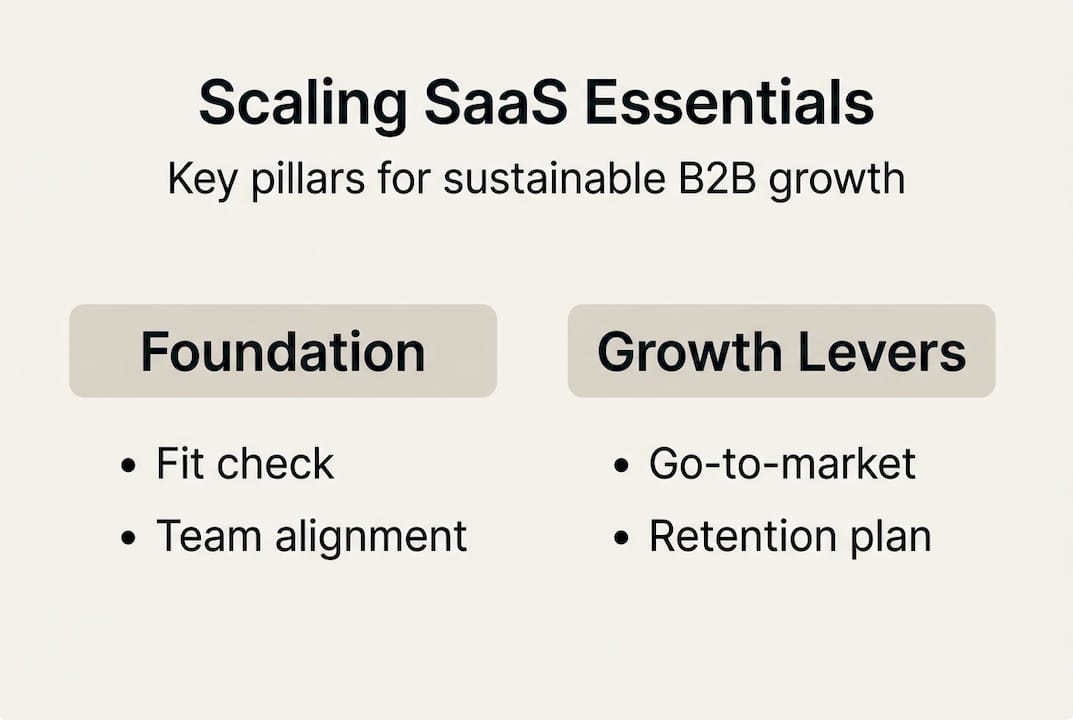
Scaling without a solid foundation is the fastest route to expensive failure. Before you increase headcount, ad spend, or sales capacity, you need to verify that the fundamentals are genuinely in place.
Start by confirming product-market fit using hard data, not gut feeling. Look at churn rate, monthly active usage, and Net Promoter Score. If churn is above 5% monthly or engagement is inconsistent, scaling will only amplify the problem. The product-market fit signs worth tracking include strong word-of-mouth referral rates, high feature adoption, and customers who would be “very disappointed” if your product disappeared.
Next, document your Ideal Customer Profile (ICP) and buyer personas in detail. Who generates the highest Lifetime Value (LTV)? Which verticals retain longest? These answers shape every downstream decision. A well-structured SaaS content strategy depends entirely on knowing precisely who you’re targeting and why they buy.
The foundation for sustainable SaaS scaling is a documented product-market fit, clear ICP, and robust customer success framework. Without these, marketing spend becomes noise.
Here’s a quick readiness checklist before you scale:
- Monthly churn below 2% (ideally below 1%)
- Documented ICP with firmographic and behavioural data
- Baseline tracking for CAC, LTV, NRR, and ARR
- A scalable tech stack (CRM, marketing automation, analytics)
- At least one dedicated customer success resource
- Leadership alignment on growth priorities and budget
| Readiness factor | Ready to scale | Needs attention |
|---|---|---|
| Product-market fit | Validated with data | Anecdotal only |
| ICP documentation | Fully defined | Vague or missing |
| Core metric tracking | Live dashboards | Manual or absent |
| Customer success | Dedicated team or resource | Ad hoc responses |
| Tech infrastructure | Integrated and scalable | Fragmented tools |
Understanding the content marketing benefits available to SaaS brands at this stage can also help you plan your growth channels intelligently from day one.
Pro Tip: Run a 30-day data audit before committing to any scaling budget. Pull churn, NRR, and CAC figures and sense-check them against industry benchmarks. What you find will either confirm you’re ready or save you from a costly mistake.
Designing a scalable go-to-market strategy
With your foundation set, the next step is crafting a market strategy that enables repeatable, scalable revenue. A go-to-market strategy (GTM) defines how you reach, convert, and retain customers at scale. Without a deliberate GTM model, growth becomes reactive and inconsistent.
A segmented go-to-market strategy is crucial for aligning marketing, sales, and customer success at scale. The most effective GTM approaches in 2026 centre on vertical focus, not horizontal spray.
Follow these steps to build your scalable GTM:
- Identify your highest-value verticals. Use LTV and retention data to pinpoint which industries or company sizes generate the best outcomes. Prioritise two or three verticals before expanding.
- Craft segment-specific value propositions. Generic messaging loses at scale. Each vertical needs a tailored narrative that speaks to its specific pain points and desired outcomes.
- Select scalable demand generation channels. Content, Account-Based Marketing (ABM), and paid search each serve different buyer stages. Choose based on where your ICP actually spends time and make decisions informed by your go-to-market framework.
- Synchronise sales, onboarding, and support. Misalignment between these functions causes churn and poor expansion revenue. Build shared playbooks and handoff processes.
| Segment | Primary channel | Value proposition focus | Key metric |
|---|---|---|---|
| Mid-market SaaS | ABM + content | Efficiency and ROI | Pipeline velocity |
| Enterprise | Outbound + events | Security and integration | Deal size and NRR |
| SMB | PPC + inbound | Speed to value | CAC and churn |
For deeper channel execution, exploring ABM for SaaS and PPC for SaaS will give you tactical specifics for each approach.
Pro Tip: Test your value proposition messaging with existing customers before rolling it out to prospects. If your best clients can’t articulate why they chose you, your GTM messaging needs refining first.
Building scalable, data-driven marketing and demand generation
A strong go-to-market strategy empowers your marketing engine. Now it’s time to operationalise scalable demand generation with precision and consistency.

Content marketing drives 3x more leads for B2B SaaS firms than paid search when targeted correctly. That’s not a reason to ignore paid channels; it’s a reason to build content as your primary long-term asset while using paid to accelerate early traction.
Here’s the operational sequence we recommend:
- Build a content engine. Create pillar pages for your core topics, supported by blog posts, case studies, and comparison pages. These compound over time and reduce CAC significantly.
- Implement data infrastructure. Integrate your CRM, marketing automation platform, and analytics tools so that every touchpoint is tracked. Rely on data-driven marketing insights to inform channel investment decisions.
- Launch multi-channel campaigns. Combine PPC, retargeting, and ABM to cover different buyer stages. Each channel plays a distinct role in moving prospects through the funnel.
- Introduce multi-touch attribution. Understanding which touchpoints actually drive conversion is critical. Without attribution, budget gets misallocated to channels that look good but don’t close deals.
- Iterate monthly. Review campaign data, drop underperformers, and double down on winning channels. Stale campaigns are a silent budget drain.
Key demand generation priorities at scale:
- Pillar content and SEO to drive organic pipeline
- Video marketing for SaaS to increase engagement and conversion rates
- Retargeting to recapture high-intent visitors
- Email nurture sequences tied to behavioural triggers
- Webinars and thought leadership to build authority
For a structured approach to pipeline building, lead generation mastery provides a detailed tactical playbook worth working through.
Pro Tip: Automate your channel performance reports on a monthly cadence. Set threshold alerts for CAC increases above 15% or conversion rate drops below baseline. Catch problems early before they compound.
Operational frameworks: ensuring growth is sustainable
With marketing and GTM execution underway, your company’s operational backbone becomes the next critical pillar. Marketing can generate demand. Only operational rigour can sustain it.
Operational transparency and agile feedback mechanisms accelerate SaaS revenue growth. This isn’t about bureaucracy; it’s about creating systems that scale with you.
The most effective operational frameworks for scaling SaaS companies include:
- OKRs (Objectives and Key Results): Align every team around measurable growth priorities. Review quarterly and adjust based on performance data, not assumptions.
- Real-time metric dashboards: Track NRR, churn, ARR, CSAT, and pipeline velocity in a single view. What gets measured gets managed.
- Cross-functional pods: Combine marketing, sales, and customer success into focused units organised around customer segments. This reduces handoff friction and improves retention.
- Customer feedback loops: Systematically collect and act on product feedback. The companies that scale product decisions effectively treat customer input as a product input, not an afterthought.
- Regular framework reviews: What works at £2M ARR won’t work at £10M. Schedule quarterly operational reviews to adapt your processes as the business evolves.
“The businesses that scale sustainably aren’t the ones moving fastest. They’re the ones with the clearest view of what’s working, and the discipline to act on it consistently.”
Building successful SaaS branding alongside these operational frameworks ensures your market position strengthens as your internal systems mature.
Common scaling pitfalls and how to avoid them
Knowing what to avoid can be as valuable as knowing what to do. Most SaaS scaling failures follow predictable patterns. Recognising them early gives you a significant advantage.
Premature scaling leads to a 70% higher risk of SaaS startup failure within three years. The data from startup failure reasons consistently points to the same root causes.
Here are the five most common pitfalls and how to counter them:
- Over-hiring before validating demand. Headcount growth should follow revenue signals, not funding rounds. Hire behind proven demand, not in front of projected demand.
- Measuring the wrong KPIs. Vanity metrics like social followers or website visitors feel good but don’t drive decisions. Focus exclusively on NRR, CAC, LTV, churn, and ARR.
- Premature channel or vertical expansion. Entering new markets before dominating your core segment dilutes focus and burns budget. Achieve a clear competitive position in one vertical first.
- Undervaluing customer success. Acquisition gets the attention; retention builds the business. A poorly supported customer base will churn regardless of how good your marketing is.
- Ignoring feedback loops. Teams that don’t systematically gather and act on customer input build products and campaigns based on assumptions, not evidence.
A content-led scaling approach and investing in branding for growth can help you grow sustainably without overextending your resources.
Pro Tip: Before entering any new vertical or launching a new channel, run a 90-day pilot with a fixed budget cap. Let the data decide whether to invest further, not internal optimism.
A fresh look: why scaling SaaS is more about discipline than speed
The SaaS industry has a speed obsession. Hypergrowth headlines, rapid funding rounds, and “unicorn” narratives dominate the conversation. But the most durable SaaS businesses we’ve worked with share one quality that rarely makes the news: operational discipline.
Popular wisdom tells founders to move fast and iterate constantly. That’s not wrong, but it’s incomplete. Moving fast without feedback loops and clear metrics creates chaos that compounds with every new hire and every new channel. We’ve seen companies raise £10M rounds and contract within 18 months because their operational foundations couldn’t support the velocity.
The businesses that genuinely outperform over a five-year horizon are the ones that treat content strategy as discipline, not as a campaign. They measure obsessively, iterate deliberately, and resist the urge to expand before they’ve truly dominated their core market.
Sustainable scale is a marathon. Discipline creates the conditions where luck becomes more likely. Speed matters, but only when it’s channelled through rigorous process and honest data.
Ready to scale your SaaS business? Take the next step
Moving from strategic clarity to real execution is where most founders get stuck. The frameworks in this guide give you the structure; specialist support accelerates the results. At Media House Agency, we partner with B2B SaaS founders and growth leaders to build and execute SaaS marketing strategies that are rooted in data and built for sustainable scale. Whether you need a full data-driven marketing plan or targeted support across specific channels, we bring the precision and performance focus your growth stage demands. If you’re serious about scaling without the chaos, let’s talk.
Frequently asked questions
What are the key metrics to track when scaling a B2B SaaS company?
Focus on net revenue retention (NRR), customer acquisition cost (CAC), lifetime value (LTV), churn, ARR, and pipeline velocity for a data-driven approach. Tracking NRR, CAC, and LTV enables sharper decisions at every stage of scale.
What is the biggest mistake SaaS companies make when trying to scale?
Premature scaling, such as over-hiring or entering new segments too early, causes more SaaS startup failures than any other single factor. Premature scaling increases failure risk by 70% within three years.
What role does content marketing play in scaling B2B SaaS growth?
Content marketing generates more qualified leads than paid search and supports sustained, scalable pipeline development over time. 3x more leads than paid search is achievable when content is properly targeted to your ICP.
How important is customer success when scaling a SaaS company?
Customer success is critical; retaining and upselling current clients delivers more sustainable growth than constant new acquisition. Operational frameworks including customer success are essential infrastructure for any SaaS business serious about scale.