TL;DR:
- Reducing CAC requires funnel optimization, accurate measurement, and strategic segmentation.
- Proven tactics include product-led growth, referrals, content marketing, and AI automation.
- Focus on LTV and retention alongside CAC to ensure sustainable SaaS growth.
Spiralling customer acquisition costs are one of the fastest ways to stall SaaS growth. When CAC climbs without a proportional rise in lifetime value, your unit economics quietly break down, and scaling becomes a liability rather than an asset. The good news is that reducing CAC does not require gutting your brand or slashing every marketing budget. It requires a smarter system. This guide covers the benchmarks, funnel fixes, tactical levers, and measurement habits that top SaaS companies use to bring acquisition costs under control while continuing to grow with purpose.
Table of Contents
- Understanding CAC benchmarks and what impacts cost
- Optimising your funnel: Preparation and foundational fixes
- Winning tactics: Proven ways to lower SaaS acquisition costs
- Measuring, iterating, and avoiding common mistakes
- Our take: What most SaaS leaders get wrong about CAC reduction
- Take SaaS acquisition costs further with expert guidance
- Frequently asked questions
Key Takeaways
| Point | Details |
|---|---|
| Benchmark CAC correctly | Aim for an LTV:CAC ratio above 3:1 and payback in under twelve months for sustainable SaaS growth. |
| Fix the funnel first | Audit your data, attribution, and conversion points before scaling channels to avoid wasted spend. |
| Prioritise efficient channels | Leverage tactics like product-led growth, referrals, and organic content for reliably lower acquisition costs. |
| Avoid short-term thinking | Don’t sacrifice long-term value or retention by over-optimising for ultralow CAC—balance with LTV impact. |
Understanding CAC benchmarks and what impacts cost
Customer acquisition cost (CAC) is the total spend required to win one new paying customer. It includes every pound spent on sales, marketing, tooling, and overhead directly tied to acquisition. At every stage of SaaS growth, this number shapes your ability to reinvest, raise funding, and scale sustainably.
Before you can optimise, you need a clear picture of what healthy looks like. The table below outlines current SaaS benchmarks.
| Metric | Standard benchmark | Elite benchmark |
|---|---|---|
| LTV:CAC ratio | 3:1 to 5:1 | 4:1 or higher |
| CAC payback period | Under 12 months | Under 9 months |
| Monthly churn | Below 2% | Below 1% |
| Sales cycle length | 30 to 90 days | Under 30 days |
According to CAC benchmarks, elite SaaS businesses maintain an LTV:CAC ratio above 4:1 and recover their acquisition cost in under nine months. If your numbers sit outside these ranges, you have a clear target to work towards.
Several factors drive CAC higher than it should be. The most common ones include:
- Funnel leakage: Prospects drop off at key stages without triggering any corrective action.
- Sales and marketing misalignment: Leads are passed with poor context, resulting in long, expensive sales cycles.
- Channel mix errors: Budget allocated to channels with poor fit for your ideal customer profile.
- Misattribution: Last-click reporting inflates the apparent value of certain channels and hides the true cost of others.
- Low activation rates: Users sign up but never reach the value moment, wasting the spend that brought them in.
Improving your landing page strategies is one of the fastest ways to reduce leakage and lower your effective CAC immediately. The payback period matters as much as the ratio itself. The longer it takes to recover acquisition spend, the more capital you need tied up in growth before you see a return. For most SaaS models, faster payback means more room to reinvest and compound.
Optimising your funnel: Preparation and foundational fixes
With benchmarks in mind, the next step is addressing your funnel’s weakest links before you spend another pound on growth.

One of the most common mistakes is treating CAC as a single blended number. Blended CAC hides critical problems. A channel pulling in cheap leads with 90% churn is dragging down the performance of your best-performing segments. Segment your CAC by channel, audience, and cohort. Compare attribution models using this framework:
| Attribution model | Strength | Weakness |
|---|---|---|
| Last-click | Simple to implement | Inflates value of bottom-funnel channels |
| First-click | Shows awareness channel value | Ignores nurture contribution |
| Linear | Distributes credit evenly | Can undervalue key conversion moments |
| Multi-touch | Most accurate view | Requires robust data infrastructure |
Multi-touch attribution corrects what CAC strategy nuances describe as a 40% last-click bias, giving you a far more reliable read on where your acquisition spend is actually working. The data from reporting SaaS analytics will only be as useful as the model behind it.
Before adding budget or switching tactics, run a structured audit. Here is the sequence to follow:
- Map your full acquisition funnel from first touch to activation.
- Identify where drop-off exceeds 20% between stages.
- Check whether your CRM is capturing source and channel accurately for every lead.
- Switch to or validate a multi-touch attribution model.
- Align sales and marketing on lead qualification criteria.
- Benchmark your current CAC by channel against the 3:1 LTV:CAC minimum.
Common funnel leaks appear at sign-up, at the sales handoff, and at the activation stage. Each one adds phantom cost to your CAC figure without delivering a converted customer. Fixing these is foundational work, and it has a direct impact on your SaaS marketing strategies before any tactical spend change takes effect.
Pro Tip: Fix your measurement and funnel infrastructure before scaling any channel. Scaling a leaky funnel simply amplifies waste.
Winning tactics: Proven ways to lower SaaS acquisition costs
Once your data and funnel are reliable, you can make the most of proven, scalable growth tactics. These are not theoretical. They are the methods that consistently produce results across both self-serve and high-ACV SaaS models.
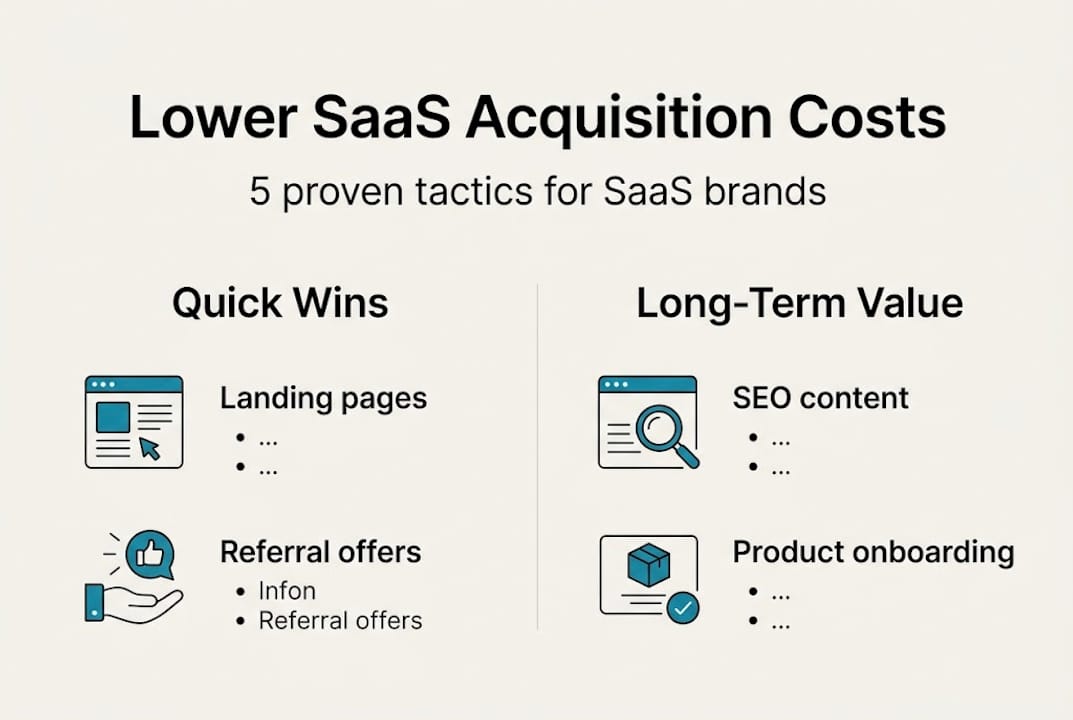
The highest ROI tactics for reducing SaaS CAC include:
- Product-led growth (PLG) with opt-out trials: Opt-out trials convert at 48 to 50%, compared to just 2 to 5% for freemium models. The product does the selling.
- Referral programmes: Referrals are up to five times cheaper than paid acquisition and typically bring in higher-retention customers.
- Content and SEO: Organic traffic compounds over time. A well-executed content strategy reduces dependency on paid spend and builds sustainable inbound volume.
- AI-powered lead scoring and automation: AI tools reduce wasted sales effort by 20 to 40% through better personalisation and smarter prioritisation. HubSpot’s AI features are a strong starting point, but audit your data quality first.
- Onboarding optimisation: Users who reach the activation milestone quickly are far more likely to convert and retain.
Channels behave very differently depending on your model. Paid search delivers speed but degrades over time without investment. Organic content marketing for SaaS compounds, meaning the cost per lead decreases as the content ages. Referrals scale with your customer base rather than your budget.
Not all high CAC is a problem. For enterprise SaaS with strong retention, a CAC above $5,000 is entirely justifiable when the payback period stays below 24 months and LTV is strong. The error is applying the same logic to a self-serve model where PLG and virality should be doing the heavy lifting. Explore SaaS conversion tactics that match your specific model.
Pro Tip: Before increasing ad spend, test improving your referral incentive and onboarding flow. Both have higher leverage and lower cost than most paid channels.
If you are running a high-velocity model, AI in SaaS marketing can cut significant waste, but only when your input data is clean and your segments are properly defined.
Measuring, iterating, and avoiding common mistakes
Implementing tactics is not enough. Continual optimisation and avoiding classic mistakes is what makes improvement sustainable over time.
Here is the right way to track and iterate on CAC reduction:
- Review CAC by channel and cohort every quarter, not just annually.
- Track payback period alongside LTV:CAC to spot deterioration early.
- Set up cohort reporting to separate acquisition quality from volume.
- Flag any channel where CAC has risen more than 15% quarter on quarter.
- Review attribution model accuracy every six months as your channel mix evolves.
The data from your customer journey analytics should feed directly into these quarterly reviews, giving you a full picture of where spend is working and where it is not.
Pitfall warning: Do not chase the lowest possible CAC. A $2,000 CAC with strong retention and high LTV outperforms a $400 CAC with 40% churn every time. Blended CAC metrics hide this distinction entirely. Strategic CAC analysis consistently shows that obsessing over low average CAC while ignoring LTV and churn is one of the most common and costly mistakes in SaaS.
Over-reliance on paid channels is another risk. Paid acquisition delivers results quickly but does not compound. Organic and referral channels take longer to build but create a more durable, lower-cost acquisition engine over time. If more than 70% of your acquisition spend is on paid channels, that is a concentration risk worth addressing. The goal is a balanced mix that reduces your average CAC naturally as organic and referral volume grows.
Our take: What most SaaS leaders get wrong about CAC reduction
We have seen a clear pattern across the SaaS portfolios we work with. The instinct when CAC rises is to cut spend, switch channels, or push for volume discounts. None of these address the root cause.
The real issue is almost always measurement and segmentation. When you treat CAC as a single number, you lose the signal entirely. The channel that looks expensive in aggregate is often the one bringing in your highest-LTV customers. The channel that looks cheap is often creating churn two quarters later.
Elite brands do not obsess over the lowest CAC. They invest in channels that compound value, generate fast learnings, and reinforce product experience. They use data-driven growth marketing to understand which segments justify higher acquisition investment and which do not.
Brand equity plays a significant role here too. A strong brand reduces CAC naturally over time as awareness and trust lower the friction in the buying journey. CAC is often a lagging indicator of brand health, not just a marketing KPI to squeeze. If your CAC is rising, it is worth asking whether your brand positioning and product experience are strong enough to do some of the work for you.
Take SaaS acquisition costs further with expert guidance
If you want an expert partner to put these strategies into action faster, here is how we can help.
At Media House Agency, we have spent five years engineering efficient acquisition systems for SaaS brands and purpose-led businesses. We bring the same analytical rigour to your funnel that Silicon Valley growth teams apply to theirs. Whether you need to build out your SaaS for marketing ROI strategy, develop a digital marketing plan for SaaS, or invest in branding for SaaS growth that reduces friction across the funnel, we build systems designed to perform. Ready to lower your SaaS CAC? Let our team tailor the right growth playbook for your stage and model.
Frequently asked questions
What is a healthy LTV:CAC ratio for SaaS in 2026?
A healthy LTV:CAC ratio sits between 3:1 and 5:1, with elite SaaS companies achieving 4:1 or higher. Ratios below 3:1 suggest your acquisition spend is not generating sufficient return.
Which channels offer the lowest CAC for SaaS companies?
Referrals and content-led SEO consistently deliver the lowest CAC. Referrals cost five times less than paid acquisition and tend to bring in customers with stronger long-term retention.
How does product-led growth (PLG) impact customer acquisition cost?
PLG, particularly opt-out trial models, drives significantly higher conversion rates. Opt-out trials convert at 48 to 50%, compared to just 2 to 5% for standard freemium offers, which directly reduces the cost per acquired customer.
Why shouldn’t SaaS teams focus only on lowering CAC?
Low CAC means little if it comes with high churn. A $2,000 CAC with strong retention delivers far more value than a $400 CAC tied to customers who leave within 60 days. Always assess CAC in the context of LTV and payback period.