
TL;DR:
- Most MRR stalls stem from strategy issues rather than product problems.
- Key metrics like NRR and churn should be precisely measured for informed decisions.
- Effective growth relies on pricing experiments, churn reduction, and strategic expansion from existing customers.
Stalled MRR is one of the most frustrating positions a SaaS founder can occupy. You have a product that works, customers who pay, and a team that hustles, yet the revenue line refuses to climb at the rate your model demands. The good news is that most MRR plateaus are not product problems. They are strategy problems. This guide walks you through the precise levers, from benchmarking to pricing to churn reduction and expansion, that consistently unlock growth for SaaS businesses at every stage. Each step is grounded in current benchmarks and real-world evidence, so you can act with confidence rather than guesswork.
Table of Contents
- Know your SaaS MRR metrics and benchmarks
- Optimise your pricing: models and experiments that drive MRR
- Reduce churn: what works to retain SaaS customers
- Drive expansion and upsell: boosting revenue from your base
- Supercharge acquisition with efficient, data-driven channels
- Our take: sustainable SaaS MRR growth beats the hype cycles
- Next steps: partner with experts to accelerate your SaaS MRR
- Frequently asked questions
Key Takeaways
| Point | Details |
|---|---|
| Track the right metrics | Monitoring MRR, NRR, churn, and expansion rates by stage sets the foundation for improvement. |
| Experiment with pricing | Small, data-driven pricing adjustments can lead to rapid and sizeable MRR increases. |
| Reduce churn early | Deploy onboarding automation and customer health scoring to stem revenue and logo loss. |
| Prioritise expansion MRR | As SaaS matures, focus on upsells and cross-sells, leveraging user data for context-driven offers. |
| Optimise acquisition spend | Choose efficient, data-driven acquisition channels and ensure long-term customer value outpaces the cost to acquire. |
Know your SaaS MRR metrics and benchmarks
Before you can improve MRR, you need to measure it correctly. Many SaaS teams track revenue in broad strokes and miss the signals hiding in the detail. Getting precise about your metrics is not administrative housekeeping. It is the foundation of every growth decision you make.
Key metrics to track:
- MRR (Monthly Recurring Revenue): The normalised monthly value of all active subscriptions.
- NRR (Net Revenue Retention): The percentage of revenue retained from existing customers, including expansions and contractions. A figure above 110% means existing customers alone drive growth.
- Churn rate: The percentage of customers or revenue lost in a given period.
- Expansion MRR: Additional revenue generated from existing customers through upgrades or add-ons.
- LTV:CAC ratio: The ratio of customer lifetime value to customer acquisition cost. A healthy SaaS business targets above 3:1.
Tracking these through reliable SaaS growth metrics reporting transforms raw numbers into actionable intelligence. Without that structure, you are flying blind.
MRR growth benchmarks by ARR stage:
| ARR stage | Healthy MRR growth rate |
|---|---|
| Under £1M ARR | 10–30% month-on-month |
| £1M–£10M ARR | 6–15% month-on-month |
| £10M–£50M ARR | 3–8% month-on-month |
| Over £50M ARR | 2–5% month-on-month |
MRR benchmarks by ARR stage confirm that growth expectations vary significantly depending on where you sit in the journey. A later-stage company chasing 20% monthly growth is likely burning cash unsustainably. A seed-stage company settling for 3% is leaving serious ground uncovered.
The purpose of benchmarking is not to judge your business. It is to calibrate your targets so your team pulls in the right direction. Set targets that are ambitious relative to your stage, not relative to what a TechCrunch headline said about a hypergrowth outlier.
Consistency in measurement matters as much as the metrics themselves. Decide how you count trials, paused subscriptions, and multi-year contracts normalised monthly. Apply that methodology every single month. Inconsistent definitions lead to misleading trends, and misleading trends lead to poor decisions.
Optimise your pricing: models and experiments that drive MRR
Pricing is the most underused growth lever in SaaS. Most founders set a price at launch based on gut instinct or competitor benchmarking, then leave it unchanged for years. That is a costly habit.
The three models worth understanding:
- Tiered pricing: Packages at different price points, each bundling more features. Works well when your customer segments have meaningfully different needs and willingness to pay.
- Usage-based pricing: Customers pay for what they consume. Lowers the barrier to entry and scales naturally with customer growth, though it introduces MRR variability.
- Value-based pricing: Price anchored to the measurable outcome your product delivers, not your costs. This model consistently outperforms cost-plus approaches.
Pricing experiments have delivered 25% ARR increases in 90 days, and value-based pricing outperforms cost-plus by 15–35%. Those are not marginal gains. They are business-changing shifts, and they come from deliberate experimentation rather than assumption.
How to run a pricing experiment:
- Define your customer segments clearly before changing anything.
- Choose one variable to test: price point, packaging, or billing cadence.
- Run the experiment on a defined cohort for at least 60 days.
- Measure conversion rate, average contract value, and early churn side by side.
- Implement the winning variant and document your learning for the next cycle.
You can explore our thinking on SaaS pricing strategies for more structured approaches to this process.
Pro Tip: When running pricing tests, segment by job-to-be-done rather than company size. Customers using your product to solve fundamentally different problems often have very different price tolerances, and blending them in a single test obscures the signal.
It is also worth remembering that a 1% increase in price, if it does not erode conversion, typically generates an 11% boost in profit. Price is not just a revenue dial. It is your most powerful margin dial too.
Reduce churn: what works to retain SaaS customers
Even the best pricing model falters if you cannot keep customers. Cutting churn is the highest ROI lever for sustainable SaaS MRR growth. Yet most SaaS teams treat churn as a lagging indicator and react to it after the damage is done.

The smarter approach is proactive. Build systems that surface at-risk accounts before they cancel, and respond with precision.
Churn reduction playbook:
- Customer health scores: Assign each account a score based on login frequency, feature adoption, and support ticket volume. Accounts scoring below threshold trigger a proactive outreach sequence.
- AI-assisted onboarding: Automated onboarding flows that adapt to user behaviour dramatically improve early activation. CloudMetrics cut churn 25% using AI-driven onboarding, and SmartReach reduced churn from 27% to 17.5% using a structured retention framework.
- Renewal playbooks: Start renewal conversations 90 days before expiry, not 30. Use that window to surface value delivered, address objections, and negotiate upgrades.
- NPS-triggered workflows: When a customer submits a low NPS score, route them immediately to a customer success manager rather than a generic email.
- Usage alerts: When engagement drops below a defined threshold for more than two weeks, trigger an automated check-in.
Pro Tip: Build a dedicated at-risk segment in your CRM and review it weekly as a leadership team. The accounts you can save are almost always visible in the data two to three months before they churn. The issue is rarely that the signal is absent. It is that nobody acted on it.
You can see how these principles apply when you convert and retain customers at scale, and further detail on optimising SaaS onboarding covers the automation layer in depth.
Healthy SaaS businesses target annual logo churn below 5% and revenue churn below 3%. If you are above these figures, reducing churn should sit above acquisition on your priority list.
Drive expansion and upsell: boosting revenue from your base
With churn under control, the next frontier is making your existing customers more valuable through timely and relevant expansion. Expansion MRR is not just a nice supplement to new business. In mature SaaS companies, it becomes the primary driver of sustainable growth.
The logic is straightforward. You have already paid to acquire these customers. Growing revenue from them costs a fraction of what new acquisition requires. And because they know your product, conversion rates on well-timed upsells are significantly higher.
How to trigger and deliver upsells effectively:
- Map usage thresholds in your product that signal readiness for an upgrade. A customer who hits their storage limit three months in a row is telling you something.
- Set automated triggers in your CRM or product analytics tool to flag these moments.
- Deliver the upsell through the most relevant channel: in-app notification, customer success call, or targeted email sequence.
- Frame the offer around the outcome the customer will gain, not the features they will unlock.
- Track expansion MRR by cohort to understand which customer segments expand fastest and why.
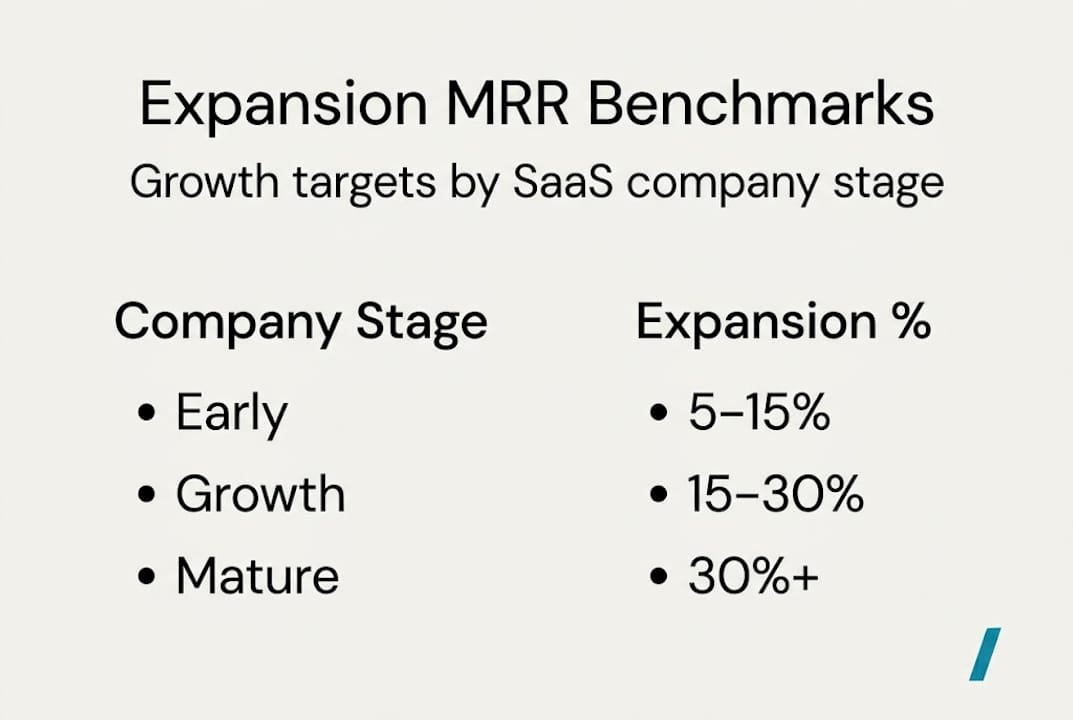
FormStack360 increased expansion revenue by 82% using automated upsell triggers tied to usage data. Expansion revenue now accounts for 6% to 11% of ARR across high-performing SaaS businesses.
| Company stage | Expansion MRR as % of total growth |
|---|---|
| Early stage | 5–15% |
| Growth stage | 15–30% |
| Mature/enterprise | 30–50%+ |
For further context on building this engine, our guide to driving marketing-led expansion and a deeper look at account-based marketing will help you structure campaigns around your highest-value accounts. You can also review Stripe’s breakdown of expansion MRR strategies for a technical framework on how expansion compounds over time.
Supercharge acquisition with efficient, data-driven channels
Efficient acquisition rounds out the MRR growth engine. At early stage, it is your primary fuel. Early-stage SaaS businesses source 85–95% of new MRR from acquisition, with an LTV:CAC target above 3:1 to ensure the economics hold.
The challenge is not finding channels. It is choosing the right ones and avoiding the traps that burn budget without producing qualified pipeline.
Common low-ROI traps in SaaS marketing:
- Broad paid social campaigns with no behavioural targeting or segmentation
- Content produced for volume rather than search intent and buyer stage
- Events attended without a clear ICP qualification process
- Outbound sequences that lack personalisation beyond first name and company name
- Partnerships announced with no co-marketing activation plan
Effective acquisition channels by approach:
- Inbound: SEO-led content, thought leadership, and community building. Slower to ramp but delivers compounding returns and lower CAC over time.
- Outbound: Targeted prospecting via email and LinkedIn, works best with a clearly defined ICP and multi-touch sequencing.
- Product-led growth (PLG): Free trials or freemium tiers where the product itself drives acquisition. Highly capital-efficient when your product has strong activation moments.
- Partnerships and integrations: Co-selling with complementary tools or platforms accelerates reach into warm audiences.
Building a disciplined inbound marketing strategy is the most sustainable path for most SaaS businesses at growth stage. Pair it with rigorous growth mix benchmarks tracking to ensure your spend allocation stays in line with what your stage demands.
Our take: sustainable SaaS MRR growth beats the hype cycles
Having covered the execution, it is worth stepping back to address the mindset trap we see most often. Founders who chase hypergrowth at the expense of retention are building on sand. High customer acquisition with poor NRR produces a leaky bucket that no amount of spend can fill.
The SaaS businesses we consistently see outperform over five-year horizons share a few traits. They maintain NRR above 110%, which means their existing customer base expands faster than it contracts. They price on value, not on fear of losing deals. And they treat expansion revenue as a primary growth engine, not an afterthought.
Raw customer count is a vanity metric if your best customers are quietly reducing their spend or churning without notice. The quality of your revenue matters more than the volume. A focused investment in customer journey optimisation will reveal more sustainable growth opportunity than any aggressive acquisition campaign.
Sustainable growth is not slow growth. It is growth built on systems that compound. Verification and refinement at every stage, whether that is pricing experiments, churn analysis, or expansion playbooks, is what separates businesses that endure from those that peak and retract.
Next steps: partner with experts to accelerate your SaaS MRR
If this guide has surfaced gaps in your current MRR strategy, you do not have to close them alone. At Media House Agency, we work directly with SaaS founders and revenue leaders to build the systems that convert insight into measurable growth. From pricing strategy to churn reduction and acquisition optimisation, our work is grounded in the same analytical rigour this guide reflects. Explore our full range of SaaS marketing strategies or learn more about dedicated help for SaaS founders. Ready to build a smarter growth engine? Our digital marketing for SaaS service is where we start.
Frequently asked questions
What is the most effective way to increase SaaS MRR fast?
Pricing experiments and targeted expansion campaigns frequently deliver the fastest MRR uplift, with some SaaS firms reporting 25%+ ARR gains within 90 days. Combining both approaches amplifies results significantly.
What MRR growth rate is considered healthy for SaaS in 2026?
Healthy MRR growth varies by stage. 10–30% monthly is common for early-stage businesses, while 3–8% monthly is the benchmark for later-stage SaaS firms in 2026.
How important is churn reduction to MRR?
Reducing churn is critical to long-term MRR health. Cutting churn by 5% can translate into substantial compounding MRR gains and push NRR above the pivotal 110% threshold.
When should SaaS companies focus on expansion MRR?
Expansion should be built into your growth model from day one, but mature companies should target expansion as 30%+ of total growth once acquisition channels are established and churn is under control.