

TL;DR:
- Conversion success depends on customer retention and lifetime value, not just signup volume.
- Freemium models require more signups but often yield higher long-term customer value.
- Choosing the optimal model requires analyzing customer segments, product complexity, and market maturity.
Freemium models can generate six times more signups than opt-in free trials. That sounds like a growth advantage. But more signups do not automatically mean more paying customers, and many SaaS marketing leaders are making acquisition decisions based on volume metrics that tell only half the story. The real measure of your conversion strategy is not how many users enter your funnel, it is how many convert to paid, stay, and grow their accounts over time. This guide cuts through the noise, presenting the data and frameworks you need to make the right call for your specific product, market, and revenue goals.
Table of Contents
- Defining free trial and freemium models for SaaS
- Conversion rate data: free trial vs freemium
- Balancing customer lifetime value and churn
- Choosing and testing the right model for your SaaS
- Why the best conversion model is rarely obvious
- Accelerate your SaaS conversion growth
- Frequently asked questions
Key Takeaways
| Point | Details |
|---|---|
| Freemium boosts signups | Freemium typically attracts more users but requires many signups for each paid customer. |
| Conversion rates differ | Free trial models often achieve higher conversion rates from user to paid compared to freemium. |
| LTV matters most | Self-selected users from freemium usually deliver greater lifetime value per paid customer. |
| Test before committing | A/B testing both approaches is essential to determine what works best for your SaaS. |
| Churn is a hidden risk | Opt-out trials increase churn by converting less engaged users, lowering overall value. |
Defining free trial and freemium models for SaaS
Before comparing performance data, it pays to be precise about what each model actually means. These terms are frequently used interchangeably, and that imprecision leads to poor strategic decisions.
A free trial gives users full or near-full access to a product for a fixed period, typically 7 to 30 days. There are two dominant variants. An opt-in trial requires the user to actively choose to upgrade at the end of the trial period. No credit card is required upfront. An opt-out trial requires a credit card at signup, and the user is automatically charged unless they actively cancel. Both create urgency and a clear conversion moment. Freemium, by contrast, offers a permanently free tier with limited features or usage caps. Users can stay on the free plan indefinitely, with the expectation that some percentage will eventually upgrade for more capability.
Each model serves a different kind of product and customer journey. Here is a quick breakdown of which suits which context:
- Freemium works best for viral products with network effects, such as Slack or Dropbox, products with simple onboarding, low average contract values (ACV), and very large total addressable markets
- Free trials work best for complex products needing setup time, sales-assisted B2B deals, high ACV products above £50 per month per seat, and tools where immediate value demonstration is possible
- Opt-in trials suit teams focused on user intent and lead quality over raw volume
- Opt-out trials suit products with fast time-to-value that can demonstrate ROI before the billing cycle hits
Understanding these distinctions directly affects how you approach lower SaaS acquisition costs. Choosing the wrong model inflates your cost per paid acquisition without you even realising it.
With foundational terminology clarified, it is vital to see how conversion rates and signup volumes compare for each model.
Conversion rate data: free trial vs freemium
Raw conversion rates are where many assumptions break down. The numbers are well-documented, but the context around them is what drives smart strategy.
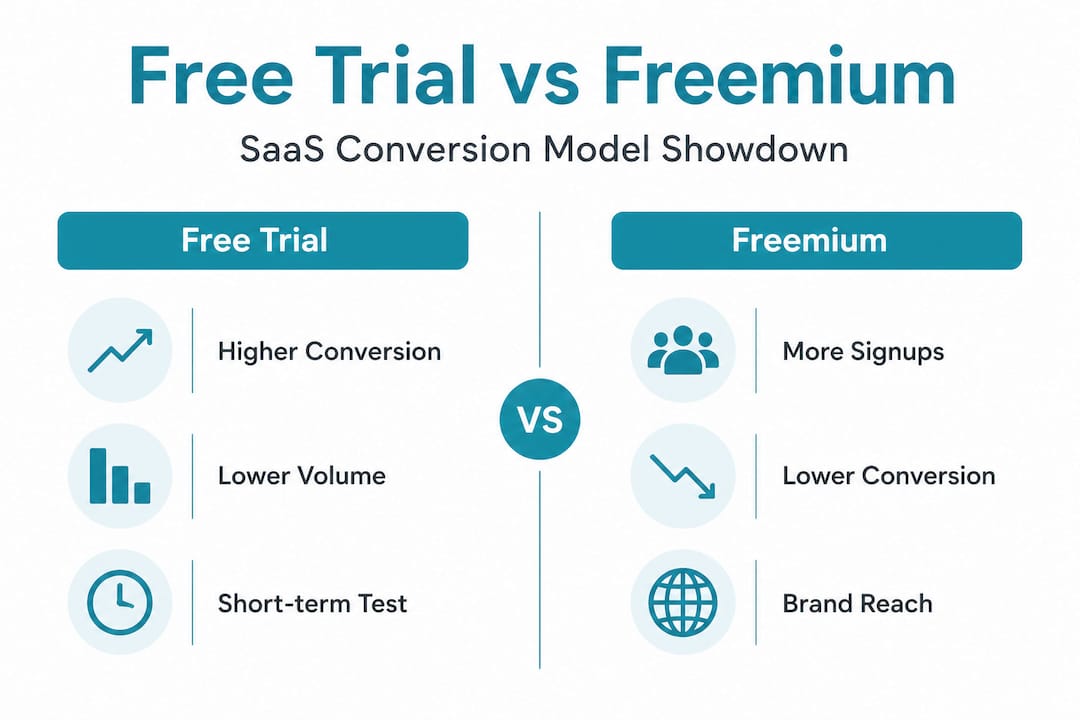
Freemium free-to-paid conversion rates sit at a median of 2 to 5 percent. That means for every 100 users who sign up for your free plan, between 2 and 5 will ever pay you anything. Opt-in free trials typically convert at between 15 and 25 percent. Opt-out trials, because of the friction of requiring payment details upfront, often convert even higher in the short term but carry their own risks, which we will cover in the next section.
The critical comparison is this: to acquire the same number of paid customers, a freemium model requires six times more signups than an opt-in free trial. That has direct implications for your marketing budget, your infrastructure costs, your support team load, and your product team’s bandwidth.

Here is how the models compare at a glance:
| Metric | Freemium | Opt-in trial | Opt-out trial |
|---|---|---|---|
| Typical free-to-paid conversion | 2 to 5% | 15 to 25% | 25 to 40% |
| Signup volume potential | Very high | Moderate | Lower |
| Signups needed per paid user | ~60 to 100 | ~5 to 10 | ~3 to 6 |
| Sales friction | Low | Low to medium | Medium to high |
| Upfront revenue predictability | Low | Medium | High |
The danger of optimising for signup volume is that it can mask fundamental weaknesses in your product’s value proposition. A freemium funnel flooded with passive users is not a growth engine. It is a resource drain dressed up as traction.
To translate this into revenue, you need to pair conversion rate analysis with robust downstream tracking. Tools and strategies outlined in our boost SaaS conversions guide will help you build that tracking infrastructure correctly. You can also look at how leading teams increase conversion rates through behavioural segmentation and funnel analysis at the event level.
The headline conversion rate is only the beginning. What happens to those converted customers over time matters just as much, often more.
Balancing customer lifetime value and churn
Conversion rate tells you who pays. Customer lifetime value (LTV) tells you how much they are worth. These two metrics rarely move in the same direction across models, and that tension is where the real strategic insight lives.
Evidence shows that freemium LTV per paid user tends to be significantly higher than opt-in or opt-out trial conversions. Benchmark figures suggest freemium converted customers are worth approximately £3,200 in LTV, compared to around £2,100 for opt-in trial conversions and £1,400 for opt-out trial conversions. The reason is self-selection. A user who upgrades from freemium has already lived inside your product, understands its value, and has chosen to invest in it deliberately. That customer is more engaged, more likely to expand usage, and less likely to churn early.
Opt-out trials tell a different story. Higher churn in opt-out trials is a direct consequence of passive conversions. Many users who signed up, forgot to cancel, and were charged are not your ideal customers. They did not experience a value moment. They experienced a billing event. The result is a spike in early-stage churn, support requests, and chargebacks that quietly erodes your margins.
Here is a data summary across the three models:
| Model | Approx. LTV per paid user | Early churn risk | Self-selection quality |
|---|---|---|---|
| Freemium | ~£3,200 | Low | High |
| Opt-in trial | ~£2,100 | Medium | Medium |
| Opt-out trial | ~£1,400 | High | Low |
Strategies to manage churn and protect LTV include:
- Segmenting onboarding flows by user intent, company size, or use case to deliver value faster
- Monitoring activation milestones rather than just login events; users who reach their first meaningful outcome are far more likely to convert and retain
- Using passive conversion data from opt-out trials to identify where users are disengaging before the billing moment and fixing those gaps in onboarding
- Building upgrade triggers within freemium products that connect with real usage patterns, not arbitrary feature locks that frustrate users
Understanding your ideal LTV to CAC ratio is essential before committing to either model at scale. If your customer acquisition cost is high and your LTV is not at least three times that figure, something in your model needs to change. You can explore a deeper treatment of this in our customer lifetime value guide. Running a conversion tracking validation playbook alongside your LTV analysis ensures that the data you are acting on is actually accurate.
Pro Tip: Use your opt-out trial passive conversion data as a product intelligence tool, not just a revenue metric. If a large proportion of users are not cancelling but also not logging in post-conversion, that signals an onboarding gap that is costing you long-term retention regardless of your acquisition model.
With LTV and churn impacts mapped, the next logical question is how to choose between models and test effectiveness in your own SaaS context.
Choosing and testing the right model for your SaaS
There is no universal winner between free trial and freemium. The right model depends on a combination of product complexity, market maturity, sales motion, and your viral coefficient. The key is to apply a structured decision framework rather than copying what larger competitors do.
Here is a practical sequence for making the call:
- Assess product complexity. If your product requires meaningful configuration or user education before delivering value, a time-boxed trial with guided onboarding is almost always stronger than an open-ended freemium plan. Freemium requires users to self-discover value, which fails with complex products.
- Evaluate your ACV. Products above £50 per month per seat typically benefit from a trial model that creates urgency and supports a sales conversation. Below that threshold, freemium with self-serve upgrade is often more efficient.
- Examine your viral coefficient. Does your product become more valuable as more people use it? Do users naturally invite colleagues or share outputs? If yes, freemium amplifies that virality. If not, a trial model protects your acquisition efficiency.
- Consider your market maturity. In a mature, competitive category, freemium can be a powerful land-and-expand mechanism. In an emerging category where buyers need education, trials allow you to guide users to the value moment before asking for commitment.
- Run a structured A/B test. Split your incoming traffic between models, hold everything else constant, and measure not just conversion rate but downstream LTV and 90-day retention. This is the only way to know which model works for your product.
- Track downstream LTV from day one. Optimising purely for conversion rate without tracking LTV leads teams to choose models that look good on weekly dashboards but damage annual revenue targets.
Applying this framework is part of how leading SaaS teams increase SaaS MRR without simply throwing more budget at top-of-funnel acquisition. How you design lead generation campaigns also changes depending on which model you are running, since the intent signals you optimise for differ significantly between freemium and trial audiences. For the technical side of running a valid split test, a structured A/B test platform guide will help you avoid common methodology errors that skew results.
Pro Tip: Always track not just your conversion rate but the LTV cohort for each acquisition model in your A/B test. A model with a 10 percent lower conversion rate but 40 percent higher LTV is almost always the better business decision at scale.
With practical strategies in place, it is time to look at what experienced marketers know that most standard analyses miss.
Why the best conversion model is rarely obvious
Here is a perspective we hold firmly at Media House Agency, built from working closely with SaaS founders and growth teams across multiple markets. The conventional free trial versus freemium debate misses something important: the unit of analysis should be your customer segment, not your product category.
Most frameworks tell you to pick a model based on product complexity or ACV. That is useful but incomplete. The more important question is: who are your highest-value customers, and which model does their decision-making process reward? A mid-market buyer evaluating project management software has a completely different journey than a solo developer using the same tool for personal productivity. The right model for one segment may actively repel the other.
We have seen this play out repeatedly. A SaaS team will launch freemium because Slack and Dropbox did it. They get impressive signup numbers. Their board is pleased. Then, six months later, their support costs have tripled, their server load has doubled, and their paid conversion numbers are essentially flat. The problem was not the model. The problem was applying a model designed for viral, low-ACV, network-effect products to a complex B2B tool that needed a sales motion to convert properly.
There is also a hidden risk in trial fatigue. Users in saturated SaaS categories have often burned through several free trials of competing products. They are sceptical, guarded, and quick to disengage if they do not see value within the first session. In these contexts, a well-designed freemium tier with a genuinely useful free plan can build more trust than a time-pressured trial. The goal shifts from urgency to demonstrated value over time.
The smartest operators we work with combine both approaches. They use freemium as a wide-funnel brand presence for individual users and run a parallel trial with sales-touch for their target enterprise segment. This is exactly the kind of market-specific growth strategy discussed in our thinking on SaaS ABM strategies, where targeting precision matters more than volume.
Customer persona analysis is the foundation that makes all of this work. Without a clear picture of who your high-LTV customer actually is, you are choosing conversion models based on gut instinct dressed up as data.
Accelerate your SaaS conversion growth
At Media House Agency, we work directly with SaaS founders and growth leaders who are ready to move beyond vanity metrics and build conversion systems that compound over time. Whether you need to sharpen your funnel with a structured approach from our SaaS conversions guide, strengthen your product’s market positioning through our branding and identity services, or build lead generation campaigns that attract the right customers rather than the most customers, we bring both the analytical precision and the creative firepower to make it happen. Explore our lead generation campaign strategies and see how we turn strategic clarity into measurable revenue growth.
Frequently asked questions
What is a typical freemium to paid conversion rate for SaaS?
Freemium conversion rates typically range between 2 and 5 percent for paid upgrades, meaning the vast majority of free users will never become paying customers without active conversion strategies in place.
Why do opt-out trials experience higher churn?
Opt-out trials see higher churn because many users convert passively, meaning they were charged before genuinely deciding the product was worth keeping, leading to rapid cancellations and low long-term retention.
How can you test which conversion model works best for your SaaS?
Running a structured A/B test between models, as recommended in evidence-based SaaS frameworks, allows you to measure not just conversion rate but downstream LTV and 90-day retention for a clear, data-driven answer.
Which SaaS products are best suited for freemium?
Products with viral network effects and simple onboarding, such as Slack or Dropbox, benefit most from freemium, particularly when the total addressable market is large and the average contract value is relatively low.
Does higher signup volume always mean more paid customers?
No. Freemium can generate dramatically higher signup volumes but requires six times more signups to produce the same number of paid customers as an opt-in free trial, making raw signup volume a misleading success metric.