

TL;DR:
- Blogging remains a powerful growth tool when built with strategic intent and quality content.
- Effective SaaS blogging integrates multiple channels, repurposes content, and aligns with product and sales strategies.
- Prioritizing quality, originality, and integration over volume is essential in an AI-saturated content landscape.
Blogging has never been more contested. With AI-generated content flooding the internet and B2B buyers skimming rather than reading, many SaaS founders and marketing leaders are quietly asking whether their blog still earns its place in the budget. The short answer is yes, but only when it is built with intent. This guide cuts through the noise to show you why blogging remains one of the most powerful growth levers in the SaaS toolkit, how it directly supports customer acquisition and brand credibility, and what you need to do differently in 2026 to make it work harder than ever.
Table of Contents
- The enduring case for blogging in SaaS
- How blogs drive customer acquisition and brand trust
- Blogging’s evolving role in the AI and multi-channel era
- Practical steps to build a blogging engine for your SaaS
- Why the value of SaaS blogging is shifting — and what most experts overlook
- Accelerate your SaaS growth with expert-led blogging and marketing
- Frequently asked questions
Key Takeaways
| Point | Details |
|---|---|
| Blogging drives SaaS growth | Strategic blogging delivers steady organic traffic, trust, and new leads for SaaS businesses. |
| Integrate channels for best ROI | Pair blogs with social, video, and AEO for the most effective customer journeys and conversions. |
| Quality outweighs quantity | High-value, original insights attract ideal buyers and differentiate your SaaS brand. |
| Systems and measurement matter | A scalable workflow and clear metrics ensure your blogging delivers continuous SaaS growth. |
The enduring case for blogging in SaaS
Let’s start with the most important question: does blogging still drive real results, or is it legacy thinking? The data is clear. Consistent, well-positioned blogging creates compounding organic traffic over time. A single high-quality post targeting the right keyword can attract qualified visitors for years without ongoing spend. That is something paid advertising simply cannot replicate at the same cost.
HubSpot is the reference case every SaaS marketer should study. Their inbound marketing dominance was built almost entirely on a sustained blogging programme that generated millions of organic visitors and positioned them as the definitive authority on marketing and sales software. They did not just write blog posts. They answered every question their buyers were asking, at every stage of the funnel, consistently for years.
The trust dimension matters just as much. When a prospective buyer lands on your blog and finds genuinely useful, expert content, they start to believe you understand their world. That belief is what closes deals. It is not the product demo alone, it is the accumulated confidence your content builds long before the demo is booked.
B2B marketers continue to rate websites, blogs, and SEO as top performance channels, with AEO (Answer Engine Optimisation) now increasing the strategic importance of well-structured blog content as AI-powered search tools scan for authoritative answers. The rules are evolving, but the fundamentals are holding.
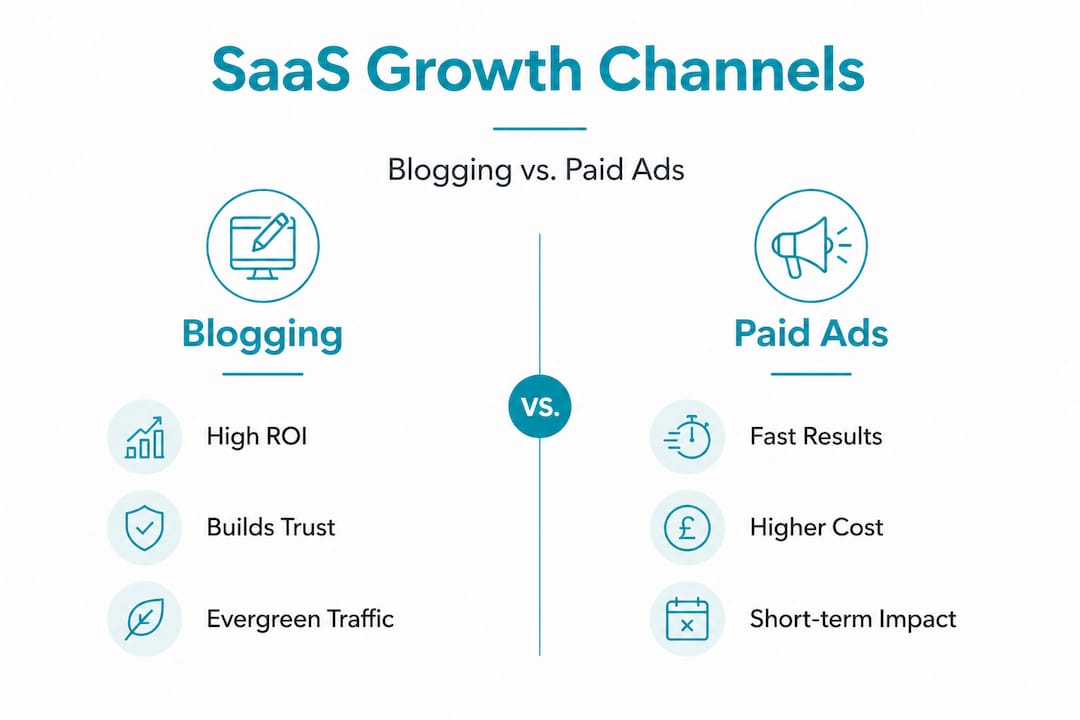
| Channel | Long-term ROI | Buyer trust building | Cost efficiency |
|---|---|---|---|
| Blogging and SEO | Very high | Very high | High |
| Paid search | Low (stops when spend stops) | Low | Low |
| Email marketing | High | Medium | High |
| Social media | Medium | Medium | Medium |
Top B2B SaaS firms continue to prioritise blogging because it serves double duty. It drives discoverability through search while simultaneously demonstrating expertise to every visitor who lands on the site. For SaaS marketing strategies that need to perform over a multi-year horizon, blogging remains a foundational investment, not a nice-to-have.
Key reasons why blogging holds its value for SaaS companies:
- Organic search rankings bring in buyers who are actively searching for solutions like yours.
- Content compounds: older posts continue attracting traffic without additional spend.
- Thought leadership differentiates you in crowded software categories.
- Buyer enablement: your content educates prospects before your sales team ever speaks to them.
How blogs drive customer acquisition and brand trust
Now that we have established blogging’s enduring value, let’s look at how it specifically delivers measurable results for SaaS acquisition and trust building.
The most direct route is SEO. When a finance director searches for “best expense management software for mid-size teams” and your blog post ranks on page one, you have an acquisition opportunity that costs you nothing at the point of contact. Scale that across dozens or hundreds of relevant queries and you have a significant, predictable lead engine. HubSpot’s sustained blogging approach proved this model at extraordinary scale, and it remains replicable for smaller SaaS players with disciplined execution.

But acquisition is only half the story. Blogs also nurture cold leads who are not yet ready to buy. A buyer might read your post on industry trends today, bookmark a case study next month, and only request a demo after six months of passive engagement with your content. This is the invisible journey that most attribution models miss, but it is one of the most powerful things your blog does.
Here is how the acquisition and trust mechanics play out step by step:
- Define your buyer’s questions. Map out the real questions your ideal customer asks at awareness, consideration, and decision stages.
- Create content that answers those questions directly. Not vaguely. Not with five hundred words of padding. With specificity and genuine insight.
- Optimise for search intent, not just keywords. Google and AI-powered search tools reward content that genuinely resolves the searcher’s problem.
- Include clear, contextual calls to action. Each post should have a logical next step: a related article, a free resource, or a product trial.
- Promote each post across channels. Email, LinkedIn, and community platforms amplify reach beyond organic search alone.
| Channel | Time to results | Cost per lead | Trust building | Longevity |
|---|---|---|---|---|
| Blogging | 3 to 12 months | Low over time | High | Multi-year |
| Paid ads | Immediate | High ongoing | Low | Zero after spend stops |
| Webinars | 1 to 4 weeks | Medium | High | Limited |
Understanding the content marketing benefits specific to SaaS companies is critical here. It is not just about traffic; it is about bringing in the right traffic and converting it with content that speaks to each buyer’s specific context.
Pro Tip: For late-funnel conversion, invest in two specific content types. First, detailed case studies that show measurable outcomes for customers similar to your target buyer. Second, technical deep-dives that demonstrate product capability at a level that a competitor’s blog simply cannot match. These two formats build the final layer of trust that boosts SaaS conversions when prospects are close to a decision.
Blogging’s evolving role in the AI and multi-channel era
The rules have changed. That is not a reason to abandon blogging; it is a reason to evolve how you approach it.
AI tools are enabling every SaaS marketing team to publish more content than ever before. The result is a web saturated with average, interchangeable posts that answer the same questions in the same way. If your blog strategy is primarily about volume, you are competing in the wrong race. According to the Content Marketing Benchmarker Report, blogs are still a core channel but their solo impact is declining, with only 11% of marketers citing a blog alone as their top growth driver. The solution is integration, not abandonment.
Important: Blogging is no longer a standalone tactic. It is the hub of a multi-format content ecosystem. When treated as such, its value multiplies significantly.
Smart SaaS firms are now combining their blogging programme with video content, social distribution, and AEO-structured content to ensure they are visible in both traditional search and AI-powered answer engines. AEO (Answer Engine Optimisation) means structuring your blog posts so that tools like Perplexity and Google’s AI Overviews can extract and cite your content as an authoritative answer. This is a technical and editorial discipline, and it is where quality clearly beats quantity.
Best practices for a multi-channel SaaS content approach in 2026:
- Treat your blog as a content hub. Every post should be the starting point for a wider content asset, not an isolated article.
- Repurpose strategically. A detailed blog post becomes a LinkedIn carousel, a short-form video, a podcast segment, and an email newsletter in a single production cycle.
- Prioritise original research and perspectives. AI cannot replicate your product team’s unique insights or your customers’ real experiences.
- Structure for AEO. Use clear headings, concise answers, and structured data where possible to improve visibility in AI-powered search results.
- Track multi-touch attribution. Blogging influences deals that your last-click reporting will credit elsewhere. Build a reporting model that captures the full journey.
Building SaaS brand affinity in this environment requires your blog to do more than inform. It needs to reflect a distinct point of view that buyers cannot find anywhere else. Pair that with video marketing for SaaS to reach the growing segment of buyers who prefer watching over reading, and your content footprint becomes genuinely competitive.
Pro Tip: Think of your blog as a content production studio, not a publishing schedule. Every article you commission should have a distribution plan before it is written, a repurposing plan once it is published, and a performance review after 90 days.
Practical steps to build a blogging engine for your SaaS
Knowing why blogging works and how it fits your multi-channel strategy is valuable. Executing it consistently is where most SaaS teams fall short. Here is a practical workflow to build a blogging engine that scales without sacrificing quality.
-
Define your personas with precision. Go beyond job titles. Map the specific questions, fears, goals, and search behaviours of your ideal buyers and users. Your content strategy lives or dies on this foundation.
-
Build a keyword and topic map. Identify the search terms your personas use at each stage of the funnel. Prioritise topics where you have genuine expertise to offer, not just topics with high search volume.
-
Create a content calendar aligned to product and sales. Your blog should reflect product launches, feature updates, and seasonal sales cycles. Marketing and product teams must communicate to make this happen.
-
Establish a quality standard. Define what a good post looks like for your brand: the depth of research required, the standard for internal expertise, the editorial review process. HubSpot’s content rigour is a major reason their blog commands the authority it does.
-
Publish, promote, and distribute. Every post needs a promotion plan. Email your list. Share on LinkedIn with a genuine commentary. Pitch relevant communities. Do not assume the algorithm will do the work.
-
Measure what matters. Track organic traffic, keyword rankings, time on page, lead source attribution, and influence on demo bookings. Review your SaaS marketing analytics on a monthly basis and adjust based on what the data shows.
-
Audit and update regularly. Posts from 12 to 18 months ago may be outdated or outranked. A content audit every quarter keeps your blog sharp and your rankings protected.
Common pitfalls to avoid:
- Publishing without a promotion strategy and wondering why traffic is flat.
- Writing for search engines instead of for your actual buyer.
- Treating blogging as a separate function from product marketing and sales enablement.
- Measuring only page views and ignoring conversion influence.
A well-structured SaaS content strategy ties your blog directly to pipeline metrics, making it a sales asset as much as a marketing channel.
Pro Tip: Repurpose your best-performing blog posts into webinars, downloadable guides, infographics, and onboarding sequences. One strong article, distributed across five formats, multiplies your reach without multiplying your production cost.
Why the value of SaaS blogging is shifting — and what most experts overlook
Here is an uncomfortable truth that the content marketing industry is slow to admit. For years, the dominant advice was “publish more.” More posts, more keywords, more traffic. Many SaaS marketing leaders still measure their blog’s success by volume metrics: posts per month, total articles published, keyword count. In an AI-dominated content landscape, that approach is not just ineffective. It is actively harmful to your brand.
When you produce average content at scale, you train your audience to expect nothing remarkable from you. You bury your genuinely insightful posts in a catalogue of filler. And you compete directly with AI-generated content on the one dimension where AI has a clear advantage: volume.
The data is telling: blogs are core to B2B strategy, but their solo impact is falling. That is not a signal to blog less. It is a signal to blog better and integrate more deliberately. The SaaS companies gaining real ground in 2026 are the ones producing fewer posts with stronger original perspectives, tighter alignment to product narratives, and genuine sales enablement value.
What most experts overlook is the role of strategic integration. A blog post that launches alongside a product update, is referenced in the sales team’s outreach, repurposed into a webinar, and cited in customer onboarding materials is worth fifty generic SEO posts. The multiplier effect of integration is where the real value sits.
We have seen this play out consistently with SaaS content strategy built around product authority rather than keyword volume. The brands that win are the ones whose blogs reflect what only they know, because of their product, their customers, and their category experience. That is something no AI tool and no competitor can replicate.
Accelerate your SaaS growth with expert-led blogging and marketing
If this article has clarified the opportunity, the next question is how to act on it without stretching your internal team beyond their capacity. At Media House, we work with SaaS founders and marketing leaders to build content and SaaS marketing strategies that convert attention into pipeline. Our approach combines rigorous audience research, funnel-aligned content planning, and data-driven SaaS marketing tracking so every piece of content earns its place in your growth engine. From initial strategy through to execution and analytics, we help you build a SaaS content strategy that reflects your brand’s authority and drives measurable results. Get in touch to discuss a personalised roadmap for your company.
Frequently asked questions
How often should SaaS companies publish blog posts?
Consistency matters more than frequency. Aim for at least two high-quality posts per month, updating existing content regularly as product features and market insights evolve.
Does blogging still bring leads despite AI content saturation?
Yes. When blogs offer genuine expertise and depth, data confirms real ROI even as AI increases overall content volume across the web.
Should SaaS blogs target buyers or users?
The most effective SaaS blogs serve both audiences, addressing decision-makers’ business outcomes alongside end-users’ specific technical challenges and daily pain points.
What KPIs matter when measuring SaaS blog ROI?
Focus on organic traffic growth, lead source attribution, time on page, keyword ranking movement, and direct influence on demo bookings or trial sign-ups.
Is it worth outsourcing SaaS blogging?
Yes, provided your partner has genuine SaaS marketing expertise, understands your buyers’ challenges, and aligns every piece of content to your specific business goals and sales cycle.
Recommended
- From Awareness to Affinity: Building a SaaS Brand People Trust – Media House Agency
- Build a SaaS inbound marketing strategy for lasting growth
- How to scale a B2B SaaS company: proven growth strategies
- Why use content marketing: key benefits for SaaS brands in 2026
- Blog — URBANEE | Digital Marketing Insights & SEO-Tipps
- Nurturing Growth, Transparency, Attention & Friction — Format-3