

TL;DR:
- Embedding systematic user research accelerates SaaS product-market fit and reduces feature waste.
- Continuous research loops increase insight velocity, improving retention, roadmap confidence, and revenue.
- Founder involvement and regular, evidence-based research practices are key to sustained SaaS growth.
Most SaaS founders treat research as a luxury they’ll afford once they hit scale. That is precisely the wrong order. Structured user research shortens product-market fit cycles by 30 to 50%, reduces feature waste, and strengthens investor readiness before you’ve burned your next runway quarter. The fastest-scaling startups are not simply outspending competitors on acquisition. They are outlearning them. This article shows you how systematic research changes outcomes across retention, roadmap prioritisation, and revenue, with frameworks you can apply immediately.
Table of Contents
- Why research is a SaaS growth accelerator, not a bottleneck
- Key research methodologies for scaling SaaS
- Embedding research loops: Tools, process and insight velocity
- Research-driven retention: The secret to faster SaaS growth
- Avoiding common pitfalls: What founders get wrong about research
- Perspective: Why systematic research, not inspiration, fuels SaaS breakthroughs
- Accelerate your SaaS growth with our data-driven strategies
- Frequently asked questions
Key Takeaways
| Point | Details |
|---|---|
| Research shortens growth cycles | Structured research speeds product-market fit while reducing wasted development. |
| Continuous insight loops matter | Ongoing research processes drive real results, not just one-off studies. |
| Retention powers faster scaling | Research helps SaaS leaders cut churn, boost net retention and outpace rivals. |
| Avoid common founder traps | Rely on experienced oversight and regular reviews—not just automation—to keep research valuable. |
Why research is a SaaS growth accelerator, not a bottleneck
The most common objection we hear from SaaS founders is simple: “We don’t have time for research.” The reality is that skipping research is what costs you time. Building features users won’t adopt, repositioning after a failed launch, or losing customers to a competitor who understood the market better — these are the true time sinks.
PMF cycles shortened by 30 to 50% when research is embedded from the outset. That is not a marginal improvement. For an early-stage SaaS company, cutting months from your go-to-market cycle can mean the difference between closing your next round and burning through cash reserves.
Here is how the mindset shift looks in practice:
- Gut-driven scaling: Build fast, ship fast, hope the market responds, patch problems reactively.
- Research-driven scaling: Validate assumptions early, build what users need, reduce rework, and enter each growth phase with confidence.
- Investor readiness: Founders with structured research pipelines present evidence-backed narratives, not opinions.
- Roadmap confidence: Research removes the internal politics around feature prioritisation. Data decides.
The numbers support this shift. Among top-performing SaaS businesses, 87% have dedicated research roles embedded within product and growth functions. These are not luxury hires. They are growth infrastructure.
“The companies that scale fastest are not the ones who build the most. They are the ones who learn the most, the fastest.”
Research also directly improves your ability to boost ROI with SaaS marketing. When you understand precisely what motivates your ideal customers, your messaging becomes sharper, your funnels convert better, and your acquisition cost falls. Every pound spent on research pays back across marketing, product, and sales. If you are building a digital marketing plan for SaaS, research is the foundation, not an optional add-on.
Key research methodologies for scaling SaaS
Understanding research’s value leads straight to the practical question: which methods drive results in SaaS right now?
Primary and secondary research methods form the backbone of a robust SaaS research programme. Primary research means gathering data directly from your market. Secondary research means interpreting what already exists. Both are essential, and they serve different purposes.
| Method | Type | Pros | Cons | SaaS use case |
|---|---|---|---|---|
| User interviews | Primary | Rich, qualitative depth | Time-intensive | Churn investigation, onboarding friction |
| Surveys | Primary | Scalable, quantifiable | Surface-level answers | NPS, feature validation |
| Usability testing | Primary | Direct behavioural insight | Requires facilitation | UX improvements, activation flows |
| Industry reports | Secondary | Broad market context | Can be outdated | Market sizing, investor decks |
| Competitor analysis | Secondary | Benchmarking, positioning | Interpretive risk | Differentiation strategy |
Quantitative vs qualitative research serves two distinct purposes. Quantitative gives you the what: usage data, conversion rates, drop-off points. Qualitative gives you the why: the reasoning, emotion, and context behind those numbers. You need both. Quantitative without qualitative tells you something is wrong. Qualitative without quantitative tells you why something might be wrong, but for one person. Combine them and you have clarity.
Here is the research loop that high-performing SaaS firms use consistently:
- Discovery: Identify the question you need answered. Frame it clearly before choosing a method.
- Data collection: Run interviews, surveys, or pull product analytics. Keep it focused.
- Synthesis: Identify patterns across responses, not just individual quotes.
- Test: Feed insights into product, marketing, or sales and run controlled experiments.
- Measure: Track impact against defined KPIs. Did retention improve? Did conversion increase?
- Iterate: Refine the question and repeat. Research is not a project. It is a rhythm.
Pro Tip: When you combine primary and secondary research in a single discovery sprint, you move faster. Start with secondary research to understand the landscape, then run targeted user interviews to validate or challenge what you find. This approach reduces the risk of building hypotheses in a vacuum.
Learning how to structure this process well is one of the highest-leverage moves when scaling a SaaS company. Most founders who stall at growth stage do so because they are running on assumptions, not evidence.
Embedding research loops: Tools, process and insight velocity
With methods chosen, the next step is operational: how do top-performing SaaS firms embed these processes into the day-to-day business engine?

Continuous research loops using tools like UserInterviews, Respondent, and Dovetail increase insight velocity, which is the rate at which your organisation moves from question to actionable decision. When research is treated as a quarterly event, you are always operating on stale data. When it runs continuously, your product and marketing teams make better decisions every single week.
Here is an example of the KPIs you should be tracking:
| KPI | What it measures | Why it matters |
|---|---|---|
| Insight velocity | Time from research question to team action | Reflects research efficiency |
| Features killed | Number of planned features dropped due to evidence | Indicates cost avoidance |
| Retention lift | MRR retained post-research-informed change | Direct revenue impact |
| Time to synthesis | Hours spent analysing findings | Identifies process bottlenecks |
| Interview cadence | Monthly research sessions completed | Research health indicator |
AI plays a real role in speeding up synthesis. Tools like Dovetail and Notion AI can tag themes across dozens of interview transcripts in minutes. That is genuinely useful. But AI summaries require human review. AI does not understand the nuance of an off-hand comment that reveals a deeper pain point. A trained researcher or an experienced founder does.
Best practices for avoiding research silos:
- Assign a named owner for each research initiative. Shared ownership means no ownership.
- Share findings in a format that non-researchers can act on. Not just a report. A decision.
- Connect research outputs to product sprint planning, not just a slide deck.
- Keep a living research repository. Avoid running the same discovery twice.
- Tie every research project to a business metric before it starts.
Pro Tip: Schedule monthly research reviews with your product and growth leads, not quarterly. SaaS markets move fast. A quarterly review cadence means you are reacting to data that is already three months old.
Your SaaS marketing analytics should be feeding into your research loops, not sitting in a separate dashboard. When your retention data, funnel metrics, and user feedback live in the same decision-making process, you move from reactive to proactive growth management.
Research-driven retention: The secret to faster SaaS growth
Embedding research is not just about processes. It transforms retention performance, which is the lifeblood of SaaS growth.
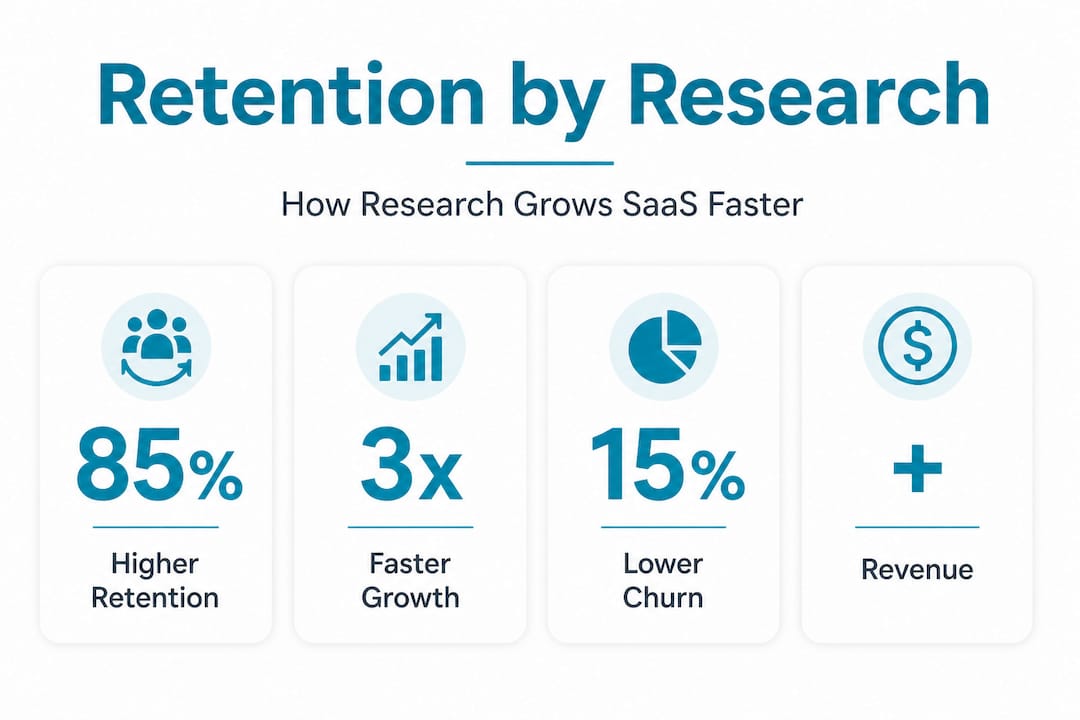
Companies with strong retention practices grow 2.5x faster than peers who focus primarily on acquisition. Churn is not a sales problem. It is a research problem. You cannot fix what you do not understand, and understanding churn requires structured, ongoing investigation into why users leave.
“Retention is not a product feature. It is the result of a sustained, evidence-driven commitment to solving real user problems.”
Here is how the research-to-retention chain works in practice:
- Pain point discovery: Regular interviews and usage analysis reveal friction points before they become cancellation triggers.
- Targeted intervention: Research findings inform specific product fixes, onboarding changes, or support touchpoints.
- Churn reduction: Addressing the root causes of dissatisfaction before users reach the point of exit.
- NRR growth: Higher gross retention compounds into stronger net revenue retention over time.
- Faster benchmarking: Research-informed companies hit upper-quartile performance metrics sooner.
The benchmarks make the stakes clear. Bootstrapped SaaS companies at £3M to £20M ARR typically see 15% annual growth with NRR around 103% and GRR around 91%. Top-quartile performers, those with strong research-informed retention strategies, achieve 42% growth and NRR of 118%. That gap is not attributable to better sales teams. It is attributable to better understanding of customers.
Understanding SaaS churn rates at a granular level is the starting point. Once you know where and when churn happens, research tells you why. And why is the only question worth answering if you want to fix it permanently.
Research also unlocks revenue expansion. When your support team feeds user frustration patterns into your research backlog, and your growth team acts on it, you create conditions to increase SaaS MRR through expansion, not just new acquisition. A well-structured SaaS inbound strategy that reflects genuine customer language, pulled from research, converts better and attracts users who are already aligned with your product’s value.
Avoiding common pitfalls: What founders get wrong about research
Knowing what works is vital, but recognising and sidestepping common traps ensures your research investment drives real growth.
Early-stage founders make three consistent mistakes with research. Avoiding these is as important as running research well.
-
Delegating research ownership to untrained team members. Research is a discipline. Asking a junior product manager to run customer discovery without guidance produces unreliable data. Founders and growth leaders need to be actively involved in designing research questions and interpreting findings. You cannot outsource your understanding of the customer.
-
Over-relying on AI-generated summaries without human review. AI synthesis tools are excellent at pattern recognition across large datasets. They are poor at identifying context, tone, and the subtle signals that expert researchers catch. A founder who reads only the AI summary of 20 interviews misses the one comment that reshapes their entire pricing strategy.
-
Treating research as a one-off event rather than a systematic habit. A single round of user interviews before launch does not constitute a research strategy. Markets evolve. User needs shift. The companies that maintain a regular research cadence are the ones who see competitive threats early and respond before losing ground.
Consider this: a SaaS company runs AI-synthesised analysis of 50 support tickets and concludes the main pain point is slow load times. Human review reveals a pattern of comments about confusing navigation buried within those same tickets, mentioned as an afterthought. The AI missed it. A trained reviewer flagged it. The product team fixed the navigation. Churn in that cohort dropped by 18% in the following quarter.
Pro Tip: Founder involvement in research design is non-negotiable, particularly in the early and growth stages. You do not need to facilitate every interview. But you must understand the questions being asked and review findings yourself. Your pattern recognition, shaped by deep product and market knowledge, is irreplaceable.
Applying research consistently also helps you optimise the B2B SaaS customer journey in ways that pure analytics cannot. Behavioural data shows you what users do. Research shows you why they do it, and why they might stop.
Perspective: Why systematic research, not inspiration, fuels SaaS breakthroughs
We have worked with enough SaaS founders to recognise a pattern. The ones who grow fastest are not the most creative. They are the most disciplined. Not in a rigid, bureaucratic sense, but in the way they approach learning. They have a system for it.
The prevailing narrative around SaaS success still glorifies the “aha moment.” The insight in the shower. The pivot that changed everything. What those stories omit is the research that preceded the insight. The dozens of customer conversations. The analysis of failed experiments. The pattern that only became visible because someone was looking for it consistently.
Gut feel is not without value. Experienced founders develop instincts that matter. But instincts without research are just expensive guesses. The strongest SaaS performers we have observed do not wait for inspiration. They create the conditions under which good decisions become almost inevitable, because they are continuously informed.
The founders who own their research cadence personally, who sit in on customer interviews quarterly, who review synthesis reports monthly, grow differently from those who delegate it entirely. They spot signals earlier. They make fewer expensive reversals. They build cultures where decisions are evidence-informed at every level.
This is not about process for its own sake. It is about building a machine that learns faster than your competitors. That is the actual growth edge in 2026, not the smartest campaign or the cleverest positioning. Systematic, founder-led research is what consistently separates the real results in SaaS marketing from the noise.
The companies that will dominate their categories in the next three years are already running research loops that their competitors have not started yet.
Accelerate your SaaS growth with our data-driven strategies
At Media House Agency, we work with SaaS founders who are serious about turning research into revenue. We bring Silicon Valley-grade analytical rigour to marketing strategy, combining data-led insight with creative execution that actually converts. If you are ready to move beyond gut-driven decisions, our marketing strategies for SaaS are built around exactly the kind of evidence-based frameworks this article covers. Explore our data-driven SaaS growth plan to see how structured research translates into measurable performance gains. For founders focused on pipeline and conversion, our guide on how to boost SaaS conversions gives you the tactical detail to act immediately. This is where research meets results.
Frequently asked questions
How often should SaaS companies conduct user research?
SaaS companies should run research continuously or at minimum monthly to stay aligned with evolving user needs and market conditions. Quarterly research reviews create dangerous blind spots in fast-moving categories.
What research methods give the biggest impact for early-stage SaaS?
Direct user interviews combined with usage metrics deliver the clearest signal at early stage, because they reveal not just what users do but why they behave that way.
How does research influence SaaS retention rates?
Research reduces churn by surfacing pain points before they trigger cancellations, and companies with strong retention practices grow 2.5 times faster than acquisition-focused peers.
What are the dangers of automating SaaS research with AI alone?
Over-relying on AI summaries without review risks missing critical contextual signals that only human interpretation catches, leading to misguided product and marketing decisions.
Recommended
- How to scale a B2B SaaS company: proven growth strategies
- Landing page – Media House Agency
- Lower SaaS acquisition costs: 5 proven strategies
- Achieve SaaS growth with the ideal LTV to CAC ratio
- Enterprise-Grade Engineering for Founders | H-Studio
- Unlock cloud scalability: cut costs and boost agility with AWS