

TL;DR:
- Clear SaaS messaging is fundamental for reducing sales cycles and increasing demo conversions by aligning teams around a compelling story. Structured, customer-validated messaging frameworks help differentiate products, build trust, and drive measurable growth, unlike generic feature pitches. Continual refinement and team alignment ensure messaging remains relevant and impactful, supporting sustained revenue and market authority.
Most SaaS founders obsess over features, pricing, and product roadmaps. Yet the real barrier to growth is often sitting in plain sight: the words you use to explain what you do. Messaging clarity links directly to shorter sales cycles and higher demo conversions when teams align around a single story. Get the message wrong, and even an exceptional product struggles to land. Get it right, and every team in your business suddenly pulls in the same direction. This article gives you frameworks and tactics to sharpen your SaaS messaging and convert that clarity into measurable growth.
Table of Contents
- Why messaging matters far more than features
- How top-performing SaaS companies structure their messaging
- From messaging to metrics: Proving impact on revenue and acquisition
- Aligning your team to maximise messaging impact
- Why most SaaS messaging efforts fall short and how to avoid it
- Next steps: Amplify your SaaS growth with proven messaging strategies
- Frequently asked questions
Key Takeaways
| Point | Details |
|---|---|
| Clarity accelerates growth | Clearly defined messaging shortens sales cycles and increases demo conversions. |
| Alignment is critical | Unified messaging across teams ensures consistent user journeys and maximises impact. |
| Measure real outcomes | Track win rates, pipeline, and revenue—not just engagement—to prove messaging’s value. |
| Make messaging a habit | Continually review and refine your messaging to stay ahead in competitive SaaS markets. |
Why messaging matters far more than features
Having set the stage for how overlooked messaging can be, let’s clarify why messaging, not features, truly shifts the growth curve.
Features get built. Markets get crowded. When every competitor can replicate your functionality within months, the thing that actually separates you is how clearly and compellingly you communicate your value. Messaging is the lens through which your ideal customer understands whether your solution is relevant to them, trustworthy, and worth their time.
Messaging is not just your tagline or homepage copy. It is the complete framework of how you frame your solution, articulate your value, and differentiate from alternatives for your ideal customers. It informs what your sales team says on discovery calls, what your content team publishes, and how your product team names features.
The business case for strong messaging is concrete. Structured messaging systems in SaaS have been linked to 40% shorter sales cycles and 3x higher demo conversion rates. Website engagement doubles when messaging is specific, relevant, and problem-led rather than feature-led. These are not marginal gains. These are the kind of shifts that change quarterly results.
Feature-based pitching is experiencing diminishing returns in competitive SaaS markets. When a prospect reads “AI-powered automation with seamless integrations,” they hear noise. When they read “cut your reporting time from six hours to forty minutes, without changing your existing tools,” they lean in. The second version is messaging doing its job.
“Messaging isn’t just a marketing asset. It is the connective tissue between your product, your market, and your revenue targets.”
Here is how messaging directly influences user perception and trust:
- Specificity builds credibility. Vague claims erode trust instantly. Precise, outcome-led language signals expertise.
- Consistent language reduces cognitive load. When prospects hear the same story from your ads, your SDRs, and your website, buying decisions feel lower risk.
- Problem-first framing accelerates qualification. Leads self-select faster when your message clearly states who you help and what problem you solve.
- Differentiated positioning reduces price sensitivity. Clear differentiation means prospects compare you less on price and more on fit.
- Aligned internal messaging reduces deal slippage. When sales, marketing, and product teams share one narrative, deals are less likely to stall due to mixed signals.
Investing in SaaS marketing strategies built on strong messaging foundations is not optional. It is the structural decision that makes every other tactic more effective.
How top-performing SaaS companies structure their messaging
Once you appreciate why messaging is essential, it is critical to see how SaaS leaders implement high-impact message structures.
The strongest SaaS messaging systems share a common architecture. They are not improvised. They are built deliberately around four core components: the pain or problem, the ideal customer profile (ICP), the core benefits, and the competitive differentiation. Each component has a specific job to do, and each informs everything downstream.
Teams that align around a single story see demonstrable business impact across pipeline quality, conversion rates, and expansion revenue. This is not a theoretical outcome. It is what happens when everyone in your go-to-market motion speaks the same language.
Here is how generic messaging compares to a structured, aligned approach:
| Element | Generic messaging | Structured, aligned messaging |
|---|---|---|
| Problem statement | Broad, assumed | Specific, validated with customer language |
| ICP definition | “SMBs and enterprises” | Named roles, industries, pain triggers |
| Core benefit | “Save time and money” | “Reduce reporting cycles by 40%” |
| Differentiation | “Best in class” | Named alternative comparison, clear contrast |
| Sales impact | Long, unclear cycles | Faster qualification, shorter close times |
| Marketing impact | Low engagement, poor targeting | Higher CTR, better qualified pipeline |
| Product impact | Feature-led roadmap | Problem-led development priorities |
The contrast is stark. Generic messaging forces every team to improvise. Structured messaging gives everyone a shared script that converts.
Here is a stepwise process to build your own SaaS messaging framework:
- Interview your best customers. Ask them what problem prompted their search, what they almost chose instead, and what made them stay. Their exact words become your messaging raw material.
- Define your ICP with precision. Go beyond firmographics. Identify the emotional and business triggers that bring your ICP to market right now.
- Map your core benefits to measurable outcomes. Each benefit should connect to a metric or tangible change in your customer’s world.
- Name your differentiation explicitly. Identify the one or two things you do that no close competitor does. Say them plainly.
- Build a single-page messaging guide. Document pain, ICP, benefits, and differentiation in one accessible reference. Make it mandatory reading for every customer-facing hire.
- Run a cross-team messaging workshop. Bring sales, marketing, and product together to align on the guide and pressure-test it against real prospect objections.
- Launch with discipline. Every new campaign, piece of content, or sales deck should be filtered through the messaging guide before it goes live.
Pro Tip: Run quarterly cross-team messaging workshops where sales reps share the objections they hear most often. These objections are the clearest signal that your message has drifted or missed the mark.
Message-market fit, the point at which your messaging resonates so precisely with your ICP that pipeline fills with qualified buyers, is as important as product-market fit. It shapes the quality of every lead you generate and the ease with which your sales team closes them. Strong thought leadership for SaaS and precise ABM strategies for SaaS both depend on this foundation being solid. Without it, even the most sophisticated tactics underdeliver.
Investing time in boosting SaaS conversions starts at the messaging layer, not the campaign layer. Fix the message before you scale the spend.

From messaging to metrics: Proving impact on revenue and acquisition
Understanding how messaging is structured, it is crucial to show how its impact can be measured and optimised for true business results.
Many SaaS teams treat messaging as a qualitative exercise. They write something that sounds good, run it, and then wonder why the numbers do not move. The problem is the absence of a measurement framework that connects messaging decisions to revenue outcomes.
The messaging-to-metrics chain works like this: product marketing leads positioning and messaging, which drives content, campaigns, and enablement, which influences pipeline quality, sales cycle length, and win rates, which ultimately shapes revenue. Every step in this chain is measurable if you set up the right tracking.
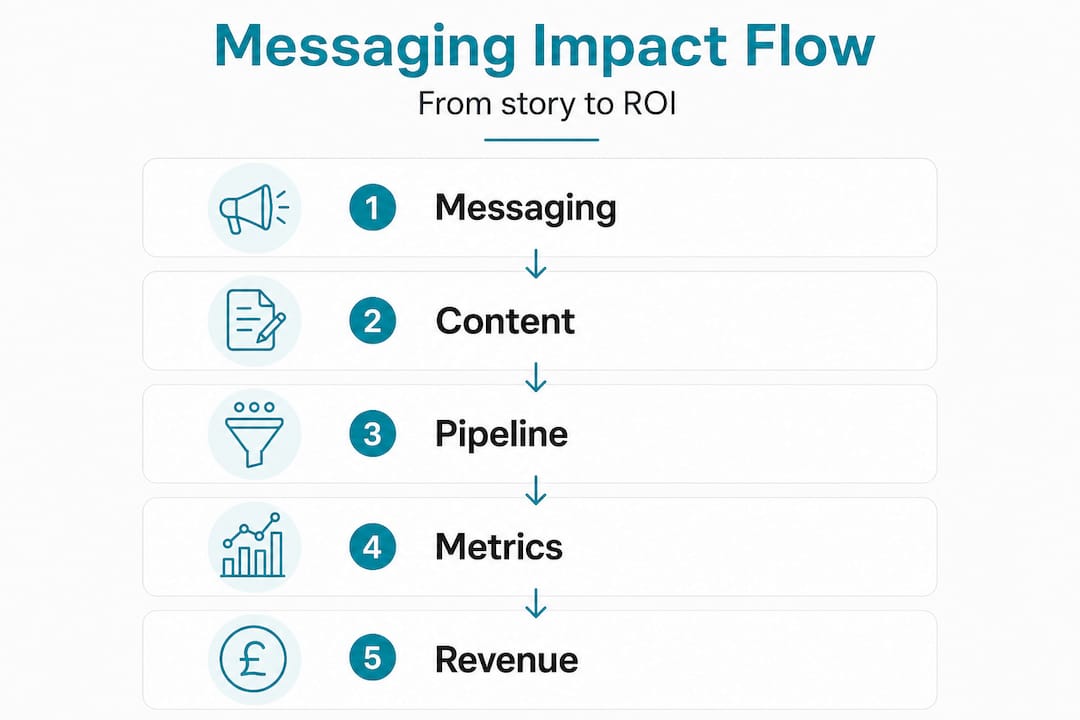
Here is what a messaging refresh can look like in practice, comparing before and after a structured implementation:
| Metric | Before messaging refresh | After messaging refresh |
|---|---|---|
| Average sales cycle | 74 days | 44 days |
| Demo-to-close conversion | 18% | 38% |
| Pipeline influenced by marketing | 31% | 61% |
| Website lead quality score | 4.2 / 10 | 7.8 / 10 |
| Expansion revenue (NRR) | 104% | 118% |
These shifts do not come from redesigning the product. They come from being clearer about who it is for and what problem it solves.
Measurable improvement of this magnitude matters. A 30-day reduction in sales cycle length, multiplied across hundreds of deals annually, represents significant revenue acceleration and reduced cost of acquisition.
Measurement should connect messaging to outcomes such as win rates, deal quality, sales enablement impact, and expansion revenue. Tracking only surface metrics like impressions, clicks, or open rates is not sufficient. Those numbers may look healthy while your pipeline quietly degrades in quality.
Leading SaaS teams are building dashboards that specifically isolate the impact of messaging on pipeline and revenue. They track which narrative resonates in which segments, which positioning wins in competitive deals, and where message drift causes late-stage drop-off.
Connecting your reporting SaaS marketing analytics infrastructure to your messaging framework gives you the feedback loop you need. Without it, you are flying blind when you make positioning decisions.
The distinction between surface engagement metrics and real business KPIs is critical. Vanity metrics can mask a messaging problem for months. High impressions with low conversion often signals that your message is attracting attention but not communicating relevance. That is a messaging failure, not a targeting failure.
Aligning your team to maximise messaging impact
With the metrics in focus, the next practical challenge is ensuring that the entire team is aligned to sustain messaging value.
Messaging alignment is not a one-time event. It is an ongoing practice. The moment your messaging framework gets locked in a folder and forgotten, drift begins. Sales reps invent their own language. Marketing teams pursue trends. Product announcements go live without messaging review. Within six months, your carefully built narrative is fragmented across every customer touchpoint.
Here are practical steps to unify your team around consistent messaging:
- Centralise documentation. Keep your messaging guide in a shared, version-controlled location that every team can access and update.
- Build messaging reviews into your launch process. No campaign, announcement, or sales deck should go live without a messaging check.
- Schedule regular resets. Revisit your messaging guide every quarter, or after major product updates, new market entry, or significant competitive shifts.
- Run onboarding through your messaging. Every new hire in sales, marketing, or customer success should be trained on your messaging framework in their first week.
- Create feedback loops from frontline staff. Customer success managers and SDRs hear how customers actually describe their problems. That intelligence should feed back into your messaging regularly.
Alignment around unified messaging shortens cycles, improves conversions, and creates measurable growth. The teams that sustain this alignment treat messaging as a living system, not a completed document.
Common pitfalls when teams are misaligned around messaging:
- Sales teams freelancing their pitch. Every rep tells a different story, making it impossible to identify what actually converts.
- Marketing chasing trends rather than strategy. Content is produced to fill a calendar rather than reinforce a position.
- Product launches with inconsistent framing. New features are announced without connecting them to the core value narrative.
- Customer success using different language. Renewal conversations feel disconnected from the original promise that sold the deal.
- Leadership communicating one story externally while teams operate on another internally.
Pro Tip: Audit your sales decks, email sequences, and website copy side by side every quarter. If a prospect experienced all three in a single week, would they hear one consistent story? If not, you have message drift to address.
Consider the downstream cost of messaging inconsistency. When a prospect hears a promise from marketing, a different angle from sales, and a different framing again at onboarding, trust erodes. They feel sold to rather than helped. Churn risk increases before the customer has even had their first meaningful product experience.
For guidance for SaaS founders on building durable growth systems, and for teams investing in SaaS branding for growth, messaging alignment is always the structural priority we address first.
Why most SaaS messaging efforts fall short and how to avoid it
Here is a candid perspective on the pitfalls and breakthroughs we have witnessed first-hand when SaaS teams invest in messaging.
The pattern we see most often is enthusiasm without follow-through. A founder reads about messaging strategy, runs a workshop, produces a beautifully written one-pager, and then moves straight into execution. The workshop was energising. The document looks sharp. But within eight weeks, the team has reverted to their old habits, and the messaging guide is gathering digital dust.
The uncomfortable truth is that messaging is not a project. It is a product. It requires a roadmap, an owner, regular iteration, and accountability. The companies that treat it like a campaign, something you launch and move on from, will always struggle to maintain the gains they initially see.
What we have seen work consistently: making messaging a living document with a named owner and a quarterly review cadence. The owner is not necessarily the CMO. Often it is a senior product marketer or, in smaller teams, a founder who remains close to the customer. What matters is that someone is accountable for keeping the message sharp, relevant, and aligned across teams.
What we have seen fail repeatedly: neglecting the input of customer-facing staff. Customer success managers and account executives carry extraordinary intelligence about how customers actually talk about their problems and their results. When messaging is developed in isolation by a small marketing team and then pushed down to frontline staff without their involvement, it rarely sticks. The language feels unfamiliar to them, so they quietly revert to what feels natural.
We have also seen companies invest heavily in integrated SaaS marketing strategies and sophisticated campaigns, only to underperform because the foundational messaging was never validated with real customers. The spend was real. The reach was real. The message just did not connect.
Our perspective, shaped by working across multiple SaaS growth journeys: a strong message is a moving target. Review it, refine it, repeat. The market shifts, competitors respond, customer language evolves, and your product deepens. Your messaging needs to keep pace with all of it. The teams that treat messaging as a quarterly operating discipline, not a one-off creative exercise, consistently outperform those that do not.
Next steps: Amplify your SaaS growth with proven messaging strategies
For SaaS companies ready to turn their messaging insights into revenue, here is where you can get tailored support.
At Media House Agency, we work directly with founders and marketing leaders to build messaging systems that are grounded in customer evidence, aligned across teams, and built to drive measurable revenue outcomes. We bring the same analytical rigour and funnel precision used in high-growth SaaS environments to help you find your message-market fit and sustain it. Whether you need support developing your positioning framework, running cross-team alignment workshops, or connecting your messaging to a data-driven SaaS growth plan, we have frameworks proven across real campaigns. Explore our SaaS marketing ROI strategies and discover how brand storytelling for SaaS turns a clear message into lasting market authority.
Frequently asked questions
What is SaaS messaging and why is it important?
SaaS messaging is how you communicate your product’s value to your ideal customers, and it is vital because messaging clarity links directly to shorter sales cycles, higher demo conversions, and stronger user engagement.
How does messaging alignment affect SaaS growth?
When teams align around clear messaging, they tell a consistent story that reduces friction across every stage of the buyer journey. Aligning around a single story produces demonstrable improvements in conversion rates and pipeline quality.
What metrics should we track to see if messaging is working?
Go beyond surface engagement. Track win rates, pipeline influenced, sales cycle length, and expansion revenue to get a true picture of your messaging’s business impact.
How often should SaaS companies revisit their messaging?
Review your messaging at least once per quarter, and always after significant product updates, market shifts, or major competitive changes, to ensure it stays relevant and effective.
What is a quick first step to improve SaaS messaging?
Audit your website, sales decks, and email sequences side by side, checking whether they tell one consistent story, then compare that story against the language your best customers actually use to describe their problem and your solution.