

TL;DR:
- Most SaaS founders mistakenly believe that building the right features will naturally attract customers, but true differentiation requires a clear, credible reason why a specific customer should choose your product.
- A practical five-step methodology starts with identifying honest competitive alternatives, then translating unique attributes into customer value, and targeting the right market segment to establish lasting competitive advantage.
Most SaaS founders believe their product will speak for itself. Build the right features, ship fast, and customers will come. It rarely works that way. The market is saturated with capable products solving similar problems, and buyers have become sophisticated enough to see through surface-level positioning. True differentiation is not about having more features than your competitors. It is about creating a clear, credible reason why a specific customer should choose you over every alternative available to them. This guide covers the methodology, the nuances, and the practical application that separates high-growth SaaS businesses from the ones perpetually grinding for traction.
Table of Contents
- Why SaaS differentiation is harder (and more critical) than ever
- The proven framework for SaaS differentiation
- From attributes to real value: What most SaaS teams miss
- Proving your differentiation: Metrics, evidence, and iteration
- Why authentic differentiation wins: Fresh lessons from the SaaS trenches
- Take your SaaS differentiation further with expert support
- Frequently asked questions
Key Takeaways
| Point | Details |
|---|---|
| True differentiation is rare | Most SaaS brands still rely on features or price instead of real value-focused positioning. |
| Frameworks make clarity repeatable | The five-step methodology provides a clear way to build, test, and refine differentiation. |
| Metrics validate strategy | Customer retention, activation, and conversion metrics show if your differentiation is working. |
| Values build lasting advantage | Ethical, purpose-led SaaS companies can create defensible market positions by owning what truly matters to their audience. |
Why SaaS differentiation is harder (and more critical) than ever
The SaaS landscape has matured significantly. What once required months of custom development can now be replicated in weeks using modern tooling and AI-assisted engineering. The result is a crowded market where product parity is the norm, not the exception. Buyers see dozens of tools that appear functionally identical. Your differentiation is not a nice-to-have. It is your commercial survival mechanism.
Several persistent myths make this problem worse:
- Feature releases signal progress, not differentiation. Shipping a new feature tells the market you are keeping pace, not pulling ahead.
- UI improvements are table stakes. A cleaner interface no longer justifies a purchase decision on its own.
- Being “easier to use” is not a position. Every competitor says the same thing.
- Lower pricing creates a race you will lose. Commoditisation follows price-led positioning with devastating consistency.
For ethical, purpose-driven SaaS companies in particular, the stakes are higher. Your values are central to your brand. Weak positioning dilutes them. If you cannot clearly articulate why your product creates distinct value, buyers default to comparing you on price. That is not where mission-led businesses want to compete.
“Positioning is not a marketing exercise. It is a strategic business decision that affects every function in the company.” This is the operating principle behind SaaS marketing strategies that actually move revenue.
The SaaS Club podcast with April Dunford makes the case clearly: a practical differentiation methodology starts with identifying real competitive alternatives, then surfaces unique attributes, translates them into customer value, and assigns that value to the segment that cares most. That sequence is deliberate and important, and most teams get it wrong by starting in the wrong place.
Strong B2B SaaS branding examples consistently show that the brands winning in competitive categories are not simply the ones with the best product. They are the ones with the clearest, most credible story about why they are the right choice for a specific kind of buyer.
The proven framework for SaaS differentiation
April Dunford’s five-step positioning methodology is the most practical framework we have seen applied successfully across SaaS businesses of different sizes and categories. It moves from market context to buyer relevance in a logical sequence. Here is how it breaks down:
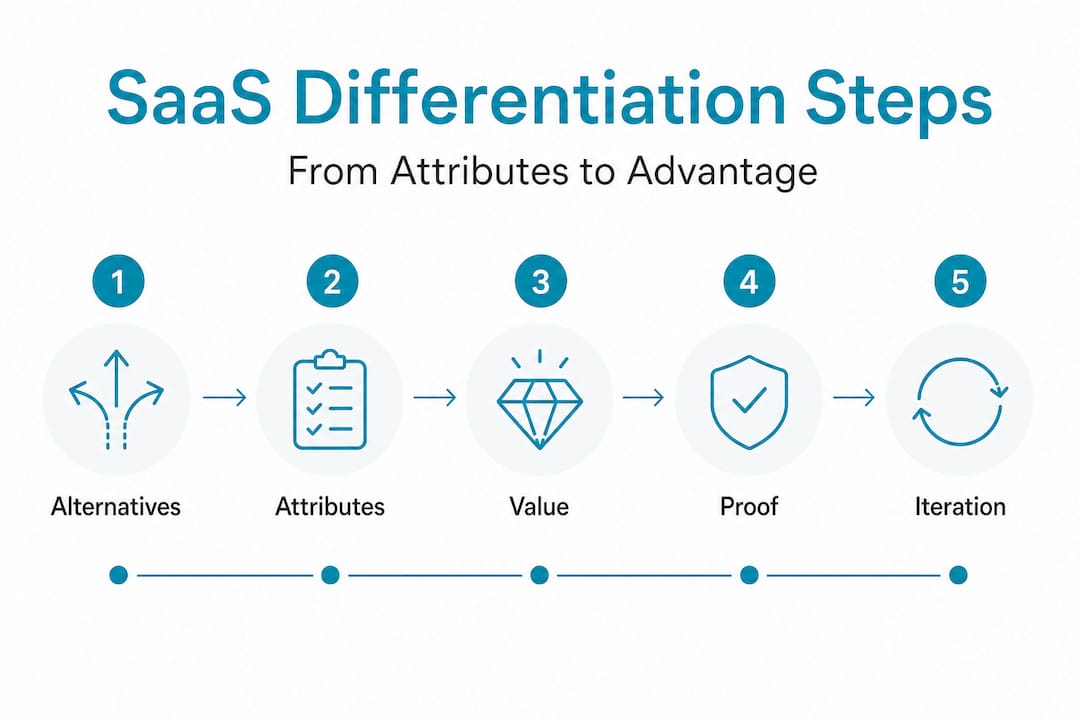
| Step | Activity | What it produces |
|---|---|---|
| 1 | Identify real competitive alternatives | Honest view of what buyers would use instead |
| 2 | Surface unique attributes | Features or capabilities competitors cannot easily replicate |
| 3 | Translate attributes to value | Customer-facing outcomes, not product descriptions |
| 4 | Identify who values this most | Target segment with highest resonance |
| 5 | Define the market category | Context that frames your value immediately |
Each step builds on the previous one. Skip a step and the whole structure weakens. Most teams jump straight to step three or four, which is why their messaging feels generic.
Here is how to work through the framework in practice:
- Start with honest competitive alternatives. Ask your best customers what they would have done had your product not existed. The answers often surprise teams. You may be competing with spreadsheets or internal processes, not the SaaS tool you assumed was your main rival.
- List only the attributes that are genuinely unique. Not just better, but meaningfully different. This requires honest internal assessment and some courage to set aside features you are proud of but that others can replicate.
- Convert every attribute into a customer outcome. “We have an API-first architecture” means nothing to a buyer. “Your team can integrate in days rather than months” means everything.
- Segment by resonance. Some customer segments will value your differentiation far more than others. Identify them precisely. Trying to speak to everyone dilutes your message.
- Choose your market category deliberately. The category you choose creates immediate expectations. Position yourself in the wrong one and even a brilliant product will be misunderstood.
The SaaS Club podcast with April Dunford reinforces that starting with competitive alternatives genuinely changes the conversation. It removes internal bias and grounds your positioning in the buyer’s actual decision-making context.
Pro Tip: Most SaaS teams default to listing internal capabilities when asked about differentiation. Run a customer interview specifically asking, “What would you have done if our product did not exist?” That answer gives you your real competitive set and the true baseline for differentiation.
Effective SaaS conversion strategies are built on precisely this kind of positioning clarity. When your messaging reflects the buyer’s actual alternatives and the genuine value you provide over them, conversion rates improve because the message resonates with lived experience. Understanding customer lifetime value in SaaS also becomes clearer once you know exactly which segment values your differentiation most. High-LTV customers are almost always the ones whose problems your unique attributes solve most directly.
From attributes to real value: What most SaaS teams miss
The most common failure point in SaaS differentiation sits between steps two and three of the framework. Teams can usually identify what makes their product different. They struggle to explain why that difference matters to the buyer. This is the “so what?” gap, and it costs companies revenue every day.
Here is a practical example of the problem:
| Attribute | What teams say | What buyers need to hear |
|---|---|---|
| Real-time data sync | “Our platform offers real-time data synchronisation” | “Your team always works from the same data, so decisions never get made on outdated information” |
| Automated compliance reporting | “We automate your compliance reporting workflows” | “Your compliance team recovers ten hours a week they can redirect to higher-value work” |
| Role-based access controls | “We offer granular, role-based permission settings” | “Sensitive data stays secure without slowing down how teams collaborate” |
The left column describes the product. The right column describes the buyer’s world after using it. Every piece of messaging your team produces should pass the “so what?” test before it goes anywhere near a customer.
The SaaS Club podcast with April Dunford places value translation at the heart of effective positioning. Unique attributes only create competitive advantage when the buyer can immediately grasp what changes in their world as a result.
Pain points are the fastest route to this translation. When you understand the specific frustrations a segment experiences with their current solution, you can frame your attributes as direct answers to those frustrations. This is not manipulation. It is relevance.
Key areas to address when translating attributes to value:
- What does the buyer lose by staying with their current solution? Frame your attribute as the fix.
- What outcome does your unique attribute make possible that was not possible before? Quantify it where you can.
- Who inside the buying organisation cares most about this outcome? Align your messaging to their role and priorities.
- Is the value credible? Claims need supporting evidence. Case studies, data, and customer quotes are not optional extras.
Building customer trust is inseparable from this process. Buyers in ethical markets are particularly attuned to whether a brand’s claims are substantiated or simply aspirational. Value claims without evidence erode trust rather than building it.
Pro Tip: Build a “value translation matrix” internally. Map every unique attribute to a specific buyer pain point, an outcome statement, and at least one piece of supporting evidence. Use it as a filter for every piece of marketing content your team produces.
Proving your differentiation: Metrics, evidence, and iteration
Knowing your differentiation is one thing. Knowing whether it is actually working in the market is another. Many SaaS leaders invest heavily in positioning work and then fail to connect it to measurable outcomes. This is a strategic gap that limits growth.
Here are the key metrics to track as evidence that your differentiation is resonating:
- Trial-to-paid conversion rate. If your differentiation is working, the right buyers find the product immediately valuable and convert at higher rates. A stagnant or declining conversion rate often signals a positioning or messaging misalignment.
- Time-to-activation. When differentiation is clear, new users understand the product’s core value quickly and reach meaningful activation faster. Slow activation suggests your product’s unique value is buried or unclear in the onboarding experience.
- Win rate against specific competitors. Track not just overall win rate but win rate in head-to-head situations. This tells you whether your differentiation holds up under direct competitive scrutiny.
- Net Revenue Retention (NRR). Customers who stay and expand their usage are validating that your differentiation is delivering sustained value. NRR is one of the clearest signals that your positioning reflects reality.
- Messaging resonance in paid and organic channels. Monitor which value propositions generate the highest click-through and engagement rates. Data from your channels tells you which differentiation themes land most effectively with your target segment.
Effective SaaS performance measurement, including activation and retention metrics, provides concrete evidence of whether your differentiation is landing and improving outcomes over time.
Iteration is not optional. Market conditions shift, competitors catch up, and buyer priorities evolve. The companies that sustain differentiation over time treat it as a living discipline, not a one-time positioning exercise. Run quarterly reviews that bring together sales, marketing, and product to assess whether your differentiation claims are still holding up in the market.
SaaS marketing analytics plays a critical role here. Without clean, reliable data on how your messaging performs at every stage of the funnel, you are guessing. Structured analytics transforms differentiation from a strategic belief into a measurable, improvable system.

Mapping the B2B SaaS customer journey through a differentiation lens also reveals where your positioning breaks down. Often, the strategy is sound but execution gaps appear in specific journey stages, particularly in onboarding or mid-funnel nurture. Identifying and fixing those gaps compounds the value of your positioning work significantly.
Why authentic differentiation wins: Fresh lessons from the SaaS trenches
Here is the uncomfortable truth most positioning frameworks do not address. You can execute every step perfectly and still fail if your differentiation is not rooted in something real about your organisation.
We see this pattern repeatedly. A founding team identifies a genuinely unique attribute, builds compelling messaging around it, and then fails to deliver consistently on that promise at the customer experience level. The positioning worked. The product and operations did not back it up. Churn follows.
Chasing competitors is the other common failure mode. When teams obsess over what the market is doing and adjust their positioning reactively, they converge toward the centre. They stop being interesting. Buyers notice this. “We are basically like X but better” is not a position. It is an admission that you have not done the work.
Authentic differentiation starts internally. It asks what is genuinely, durably true about your product, your team, and the outcomes you create. For ethical SaaS businesses, company values are a legitimate source of differentiation when they are embedded in the actual product and customer experience. They are not marketing language. They are operational commitments that buyers can verify.
SaaS thought leadership is one of the most underused differentiation tools available to founders. When your team consistently produces insight that helps your target segment think more clearly about their problems, you accumulate credibility that competitors cannot replicate by releasing a feature. That credibility compounds over time and creates a gravitational pull toward your brand that no amount of ad spend can manufacture.
The lesson we would leave you with is this: differentiation is not a marketing problem. It is a leadership decision. The clearest, most lasting competitive advantages are built by founders and marketing leaders who decide to be genuinely excellent at something specific and then organise every customer-facing element of their business around that decision.
Take your SaaS differentiation further with expert support
Differentiation at this level requires more than a good framework. It requires strategic discipline, analytical rigour, and the ability to translate positioning clarity into every layer of your go-to-market execution. At Media House, we work with ethical SaaS founders and marketing leaders to build brand positioning expertise that is commercially precise and values-aligned. From foundational positioning workshops to full-funnel campaign architecture, our approach is built to create measurable separation from your competitors. Explore the B2B SaaS branding benefits that a strategically sound brand creates, and see how our branding and identity services can help you build the kind of market presence that converts attention into sustained revenue.
Frequently asked questions
How does SaaS differentiation impact customer retention?
Strong differentiation directly boosts retention by giving customers a clear, ongoing reason to stay. When buyers chose you for a specific, well-defined value, activation and retention metrics consistently reflect that clarity through higher renewal and expansion rates.
What are the first signs my SaaS is not differentiated enough?
Low win rates, price-led negotiations, and an inability to clearly articulate your unique value are the most telling early signals. A practical differentiation methodology beginning with competitive alternatives quickly reveals where the gaps lie.
Can differentiation be measured with SaaS metrics?
Yes. Trial-to-paid conversion, time-to-activation, and NRR all provide direct evidence of whether your differentiation is resonating. SaaS performance measurement gives you the data to improve positioning over time with confidence.
Is SaaS differentiation mostly about features?
No. Features describe the product. Differentiation is about the distinct value those features create for a specific buyer. Translating unique attributes into clear customer outcomes is where real competitive advantage is built.