
Digital marketing remains one of the most misunderstood aspects of B2B SaaS growth. Many marketing leaders face an overwhelming array of channels, tactics, and technologies without clear guidance on what truly drives results. This confusion often leads to scattered efforts, wasted budgets, and missed opportunities for meaningful customer engagement. This guide cuts through the noise to explain digital marketing fundamentals, proven strategies, and emerging trends specifically for B2B SaaS companies in 2026. You’ll gain practical insights to refine your approach, optimise lead generation, and build lasting customer relationships through data-driven digital marketing.
Table of Contents
- Understanding The Fundamentals Of Digital Marketing For B2B SaaS
- Key Digital Marketing Strategies And How They Drive SaaS Growth
- Measuring And Analysing Digital Marketing Performance In SaaS
- Advanced Digital Marketing Tactics And Future Trends For B2B SaaS
- How Media House Agency Can Transform Your SaaS Digital Marketing
Key takeaways
| Point | Details |
|---|---|
| Digital marketing integrates multiple channels | Successful B2B SaaS marketing combines SEO, PPC, content, email, and social media into a cohesive strategy. |
| Measurement drives optimisation | Tracking CAC, MQL, conversion rates, and LTV enables continuous improvement and better resource allocation. |
| AI transforms personalisation | Advanced technologies enable smarter targeting, predictive insights, and automated campaign management for competitive advantage. |
| Strategy must align with buyer journey | Effective digital marketing maps tactics to awareness, consideration, and decision stages to reduce friction. |
| Emerging trends require adaptation | Account-based marketing, unified AI/SEO strategies, and predictive analytics are reshaping B2B SaaS marketing in 2026. |
Understanding the fundamentals of digital marketing for B2B SaaS
Digital marketing integrates various channels to attract, engage, and convert potential customers through online platforms. For B2B SaaS companies, this encompasses a strategic blend of tactics designed to reach decision makers, demonstrate product value, and build trust throughout extended sales cycles. Understanding these fundamentals helps you allocate resources effectively and create campaigns that resonate with your target audience.

Inbound marketing focuses on attracting prospects through valuable content, SEO, and social media engagement. This approach positions your brand as a trusted resource, drawing potential customers who actively seek solutions. Outbound marketing involves proactive outreach through PPC advertising, email campaigns, and targeted messaging to specific accounts or segments. Both approaches serve distinct purposes in your overall strategy.
Content marketing forms the foundation of successful B2B SaaS digital marketing. You create educational materials like blog posts, whitepapers, case studies, and videos that address prospect pain points and demonstrate your expertise. This content supports SEO efforts, nurtures leads, and provides sales teams with valuable resources throughout the buyer journey.
Search engine optimisation improves your visibility in organic search results, helping prospects discover your solutions when researching problems or evaluating vendors. Pay-per-click advertising delivers immediate visibility and precise targeting, allowing you to reach specific audiences based on demographics, behaviour, and intent signals. Together, these tactics create a comprehensive digital presence.
The key to effective B2B SaaS digital marketing lies in integration. Each channel should complement others, creating multiple touchpoints that guide prospects from awareness through consideration to decision. Your digital marketing services strategy must align with buyer personas, address specific pain points at each journey stage, and deliver consistent messaging across all platforms.
Critical components working together include:
- SEO driving organic discovery and establishing thought leadership
- PPC providing immediate visibility and testing messaging effectiveness
- Content marketing educating prospects and supporting sales conversations
- Email automation nurturing leads and maintaining engagement
- Social media building community and amplifying brand reach
- Analytics tracking performance and informing optimisation decisions
Key digital marketing strategies and how they drive SaaS growth
Effective digital marketing requires selecting and executing strategies that align with your business objectives and target audience behaviour. Each approach offers distinct advantages, and understanding their applications helps you build campaigns that generate qualified leads and accelerate pipeline growth.
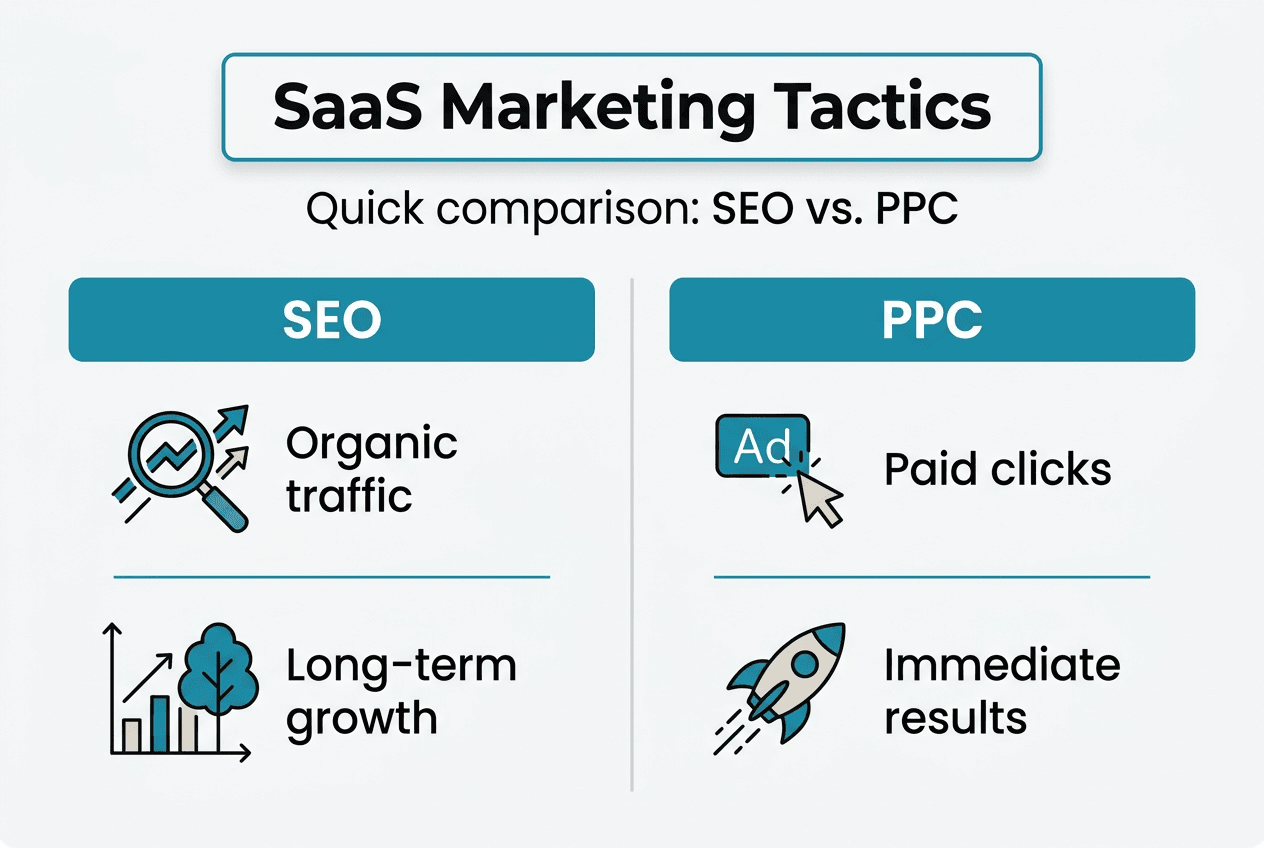
Search engine optimisation delivers sustainable, long-term results by improving your organic visibility for high-intent keywords. This strategy builds authority, reduces customer acquisition costs over time, and captures prospects actively researching solutions. PPC is essential for immediate visibility and testing messaging before committing to longer-term content investments.
| Strategy | Primary Benefit | Best Application | Timeline |
|---|---|---|---|
| SEO | Sustainable organic traffic | Long-term authority building | 6-12 months |
| PPC | Immediate qualified traffic | Product launches, testing | Immediate |
| Content Marketing | Trust and education | Nurturing and thought leadership | 3-6 months |
| Email Automation | Efficient lead nurturing | Relationship building | Ongoing |
Content marketing establishes your expertise whilst addressing prospect questions throughout their decision journey. Create materials that speak directly to pain points, demonstrate ROI, and provide actionable insights. This positions your brand as a valuable resource rather than just another vendor pushing products.
Implementing effective campaigns requires systematic execution:
- Define clear objectives aligned with revenue goals and buyer journey stages
- Identify target audience segments based on firmographics, behaviour, and intent signals
- Develop messaging frameworks that address specific pain points and differentiate your solution
- Create content assets optimised for each channel and journey stage
- Launch campaigns with proper tracking and attribution mechanisms in place
- Monitor performance metrics daily during initial phases to identify issues quickly
- Optimise based on data, testing variables like messaging, targeting, and creative elements
- Scale successful campaigns whilst maintaining efficiency metrics
Pro Tip: Allocate 20-30% of your PPC budget to testing new audiences, messaging angles, and landing page variations. This experimentation uncovers opportunities that dramatically improve campaign performance whilst your core campaigns maintain steady lead flow.
Social media marketing plays a nuanced role in B2B SaaS, focusing less on direct lead generation and more on brand building, community engagement, and amplifying content reach. LinkedIn remains the primary platform for reaching decision makers, whilst Twitter and niche communities offer opportunities for thought leadership. Understanding social media marketing potential helps you set realistic expectations and integrate these channels effectively.
Email automation nurtures leads efficiently, delivering personalised content based on prospect behaviour and journey stage. Segment your audience by industry, company size, engagement level, and identified pain points to ensure relevance. Automated sequences maintain consistent touchpoints without overwhelming your team, moving prospects closer to sales-ready status.
Measuring and analysing digital marketing performance in SaaS
Data-driven decision making separates successful digital marketing programmes from those that waste resources on ineffective tactics. Accurate measurement and optimisation enable you to identify what works, allocate budgets efficiently, and demonstrate clear ROI to stakeholders.
Customer acquisition cost measures the total marketing and sales expense required to win a new customer. This metric helps you evaluate channel efficiency and set sustainable growth targets. Marketing qualified leads represent prospects who meet specific criteria indicating genuine interest and fit, serving as a leading indicator of pipeline health.
Conversion rates at each funnel stage reveal where prospects drop off and where optimisation efforts should focus. Tracking conversions from visitor to MQL, MQL to SQL, and SQL to customer highlights friction points in your buyer journey. Lifetime value quantifies the total revenue a customer generates, informing how much you can profitably spend on acquisition.
| Metric | Definition | Why It Matters | Target Benchmark |
|---|---|---|---|
| CAC | Total cost to acquire one customer | Determines profitability and scalability | 3:1 LTV:CAC ratio |
| MQL | Leads meeting qualification criteria | Indicates top-of-funnel health | 5-10% of traffic |
| Conversion Rate | Percentage advancing between stages | Reveals friction points | 2-5% visitor to MQL |
| LTV | Total revenue per customer | Justifies acquisition investment | 3x CAC minimum |
Google Analytics provides foundational website behaviour data, showing how visitors find and interact with your content. Marketing automation platforms like HubSpot or Marketo track lead nurturing effectiveness and attribute revenue to specific campaigns. CRM systems connect marketing activities to closed revenue, demonstrating true business impact.
Integrating these platforms creates a complete view of your marketing performance. Connect Google Analytics to your CRM to track which traffic sources generate the highest-value customers. Link your marketing automation platform to advertising accounts to optimise campaigns based on downstream conversion data, not just initial form fills.
Key performance indicators to monitor include:
- Channel-specific metrics like organic traffic growth, PPC cost per MQL, and email open rates
- Funnel progression rates showing how efficiently leads move through qualification stages
- Content performance data revealing which assets drive engagement and conversions
- Revenue attribution showing which campaigns and channels influence closed deals
- Customer cohort analysis tracking retention and expansion by acquisition source
Pro Tip: Implement AI to streamline analytics and surface insights faster. Machine learning algorithms identify patterns humans miss, predict which leads are most likely to convert, and recommend optimisation actions based on historical performance data.
Regular reporting maintains accountability and informs strategic decisions. Create dashboards that display real-time performance against targets, making data accessible to stakeholders at all levels. Monthly reviews should assess progress towards objectives, identify trends, and adjust tactics based on what the data reveals.
Advanced digital marketing tactics and future trends for B2B SaaS
The digital marketing landscape continues evolving rapidly, with emerging technologies and methodologies reshaping how B2B SaaS companies attract and engage customers. Staying ahead of these trends provides competitive advantages and positions your brand as an industry leader.
Artificial intelligence enables unprecedented personalisation at scale. Machine learning algorithms analyse prospect behaviour to deliver tailored content recommendations, predict optimal send times for email campaigns, and identify high-intent signals that indicate sales readiness. This technology transforms generic marketing into highly relevant experiences that resonate with individual prospects.
Account-based marketing focuses resources on high-value target accounts rather than broad lead generation. This approach aligns marketing and sales teams around specific companies, creating coordinated campaigns that engage multiple stakeholders within each account. ABM delivers higher conversion rates and deal sizes by concentrating efforts where they matter most.
Unified AI and SEO strategies represent a significant shift in how companies approach search visibility. Beyond traditional keyword optimisation, this approach optimises content for AI-powered search tools and conversational queries. As prospects increasingly use AI assistants to research solutions, ensuring your content appears in these results becomes critical.
| Approach | Traditional Marketing | AI-Enabled Marketing |
|---|---|---|
| Personalisation | Segment-based messaging | Individual-level customisation |
| Timing | Scheduled campaigns | Predictive optimal moments |
| Content Selection | Manual curation | Algorithm-driven recommendations |
| Lead Scoring | Rule-based criteria | Predictive likelihood models |
Chatbots and conversational marketing engage website visitors in real-time, answering questions and qualifying leads without human intervention. These tools operate 24/7, capturing opportunities that would otherwise slip away outside business hours. Advanced implementations use natural language processing to understand intent and provide genuinely helpful responses.
Predictive analytics forecast which prospects are most likely to convert, enabling you to prioritise outreach and allocate resources efficiently. These models analyse hundreds of signals including engagement patterns, firmographic data, and behavioural indicators to score leads more accurately than traditional methods.
“The companies winning in B2B SaaS marketing are those embracing AI not as a replacement for human creativity, but as a tool that amplifies strategic thinking and executes at a scale impossible through manual effort alone.”
Emerging tactics to consider implementing:
- Intent data platforms identifying accounts actively researching solutions in your category
- Video marketing personalised with prospect names and company information
- Interactive content like assessments and calculators that engage whilst collecting qualification data
- Community building through proprietary platforms or strategic partnerships
- Podcast sponsorships reaching niche audiences with high relevance
Integrating these advanced tactics requires careful planning. Start with pilot programmes testing new approaches on a small scale before full deployment. Measure results rigorously, comparing performance against established channels to validate effectiveness. Build internal capabilities gradually, ensuring your team has the skills and tools needed to execute successfully.
The AI and SEO unified strategy approach exemplifies how forward-thinking companies adapt to changing search behaviour. By optimising content for both traditional search engines and AI-powered tools, you capture visibility across multiple discovery paths. This dual optimisation ensures prospects find your solutions regardless of which technology they use for research.
How Media House Agency can transform your SaaS digital marketing
Navigating the complexity of modern B2B SaaS digital marketing requires specialised expertise and proven methodologies. Media House Agency partners with SaaS companies to build strategic content systems that reduce sales friction, attract high-fit buyers, and accelerate growth through data-driven campaigns.
Our digital marketing services combine deep SaaS industry knowledge with technical execution capabilities. We develop integrated strategies spanning SEO, PPC, content marketing, and analytics, ensuring every tactic works together towards your revenue objectives. This holistic approach delivers better results than fragmented, channel-specific efforts.
As a specialised SaaS marketing agency, we understand the unique challenges you face: long sales cycles, multiple decision makers, complex product positioning, and intense competition. Our methodology addresses these factors through strategic messaging, targeted campaigns, and continuous optimisation based on performance data.
Explore our expertise in PPC strategies for SaaS to understand how paid advertising accelerates pipeline growth. We help you maximise return on ad spend whilst building sustainable organic visibility through content and SEO.
FAQ
What is digital marketing and why is it vital for B2B SaaS?
Digital marketing encompasses all online channels and tactics used to attract, engage, and convert potential customers into paying users of your SaaS product. For B2B SaaS companies, it’s vital because your target audience researches solutions online, evaluates vendors through digital content, and expects seamless experiences across multiple touchpoints. Effective digital marketing builds awareness, establishes credibility, generates qualified leads, and supports sales teams throughout the buyer journey, ultimately driving predictable revenue growth.
How do I choose the best digital marketing channels for my SaaS product?
Start by understanding where your target audience spends time online and how they research solutions in your category. Analyse competitor presence across channels to identify gaps and opportunities. Test multiple channels simultaneously with modest budgets, measuring cost per MQL and downstream conversion rates to determine efficiency. Focus resources on channels delivering the best combination of volume, quality, and cost-effectiveness. Explore social media marketing potential to understand how platforms like LinkedIn fit into your overall strategy.
What metrics should I track to assess my digital marketing success?
Focus on customer acquisition cost, marketing qualified leads, conversion rates at each funnel stage, and customer lifetime value for a balanced performance view. These metrics reveal both efficiency and effectiveness, showing whether you’re generating enough pipeline at sustainable costs. Track channel-specific KPIs like organic traffic growth, PPC cost per click, email engagement rates, and content performance to optimise individual tactics. Most importantly, connect marketing activities to closed revenue through proper attribution, demonstrating clear business impact to stakeholders.
How can emerging technologies like AI impact B2B SaaS marketing?
AI enables dramatically deeper personalisation by analysing prospect behaviour and delivering tailored content at individual levels rather than broad segments. It provides predictive insights that identify high-intent prospects, optimal engagement timing, and likely conversion paths, allowing smarter resource allocation. AI-powered tools automate repetitive tasks like lead scoring, email send time optimisation, and content recommendations, freeing your team to focus on strategy and creativity. Implementing AI and SEO unified strategy ensures your content remains discoverable as search behaviour evolves towards conversational and AI-assisted queries.