
TL;DR:
- Fractional CMOs offer strategic SaaS marketing expertise without full-time costs.
- Niche, industry-specific CMOs deliver faster impact and higher credibility.
- Clear goals, direct access, and aligned KPIs are crucial for success.
Scaling a SaaS business is rarely the clean, linear journey the pitch decks suggest. You are chasing aggressive revenue targets while trying to protect the brand values that made investors and customers believe in you in the first place. Many founders assume these two objectives are in conflict. They are not. The fractional CMO model is quietly becoming one of the most effective strategic levers available to SaaS leaders who refuse to choose between growth and integrity. This article defines what a fractional CMO actually does, separates fact from fiction, and gives you a clear framework for using this model to drive measurable, sustainable revenue.
Table of Contents
- What is a fractional CMO for SaaS, and why does it matter?
- Core benefits of a fractional CMO for SaaS businesses
- Choosing the right fractional CMO: niche vs generalist in SaaS
- Making the most of your fractional CMO: success factors and common pitfalls
- Why most SaaS brands underestimate the power of niche fractional CMOs
- Ready to optimise SaaS growth with a specialist?
- Frequently asked questions
Key Takeaways
| Point | Details |
|---|---|
| Fractional CMO defined | A fractional CMO brings strategic leadership to SaaS firms flexibly and effectively. |
| Niche expertise wins | SaaS businesses should favour CMOs with proven experience in their specific vertical. |
| Immediate growth impact | Well-chosen fractional CMOs can accelerate pipeline growth and demand-gen quickly. |
| Focus on measurable outcomes | Success depends on clear KPIs and transparent collaboration with your CMO. |
What is a fractional CMO for SaaS, and why does it matter?
A fractional CMO is a senior marketing leader who works with your business on a part-time or project basis, typically for a defined number of days per month. They operate at the same strategic level as a full-time Chief Marketing Officer, but without the full-time salary, benefits package, and long-term employment commitment. For SaaS companies at the growth stage, this distinction matters enormously.
The fractional CMO model is not a new concept, but its adoption in SaaS has accelerated significantly. Venture-backed startups and bootstrapped scale-ups alike are turning to it because it offers access to genuine C-suite marketing expertise without the overhead. A fractional CMO typically engages for anywhere between one and three years, embedding deeply enough to drive real strategic change.
In the SaaS context, the core responsibilities of a fractional CMO include:
- Go-to-market strategy: designing and executing the plan for how your product reaches and converts your ideal customer profile
- Demand generation: building the systems and content that attract, educate, and qualify pipeline at scale
- Positioning and messaging: ensuring your product is clearly differentiated in a crowded market
- Team leadership: managing internal marketing staff and external agencies, holding them accountable to performance
- Revenue alignment: working alongside your sales and product teams to ensure marketing directly supports ARR growth
- Brand governance: protecting the integrity of your brand as the business scales into new segments or geographies
The modern CMO roles have evolved considerably. Today’s SaaS CMO is as comfortable in a data dashboard as they are in a brand strategy session. They understand funnel economics, cohort analysis, and conversion rate optimisation. They are not just creative directors with a senior title.
Critically, the most effective fractional CMOs in SaaS are specialists, not generalists. The evidence is clear on this. As Sangram Vajre, a respected voice in B2B SaaS marketing, has noted:
“Buyers respond better when the fractional leader is specific — vertical, buyer type, or problem space.”
This is not a minor nuance. In a market where every fractional CMO claims broad expertise, the ones who win client trust and deliver results are those who can speak your buyers’ language from day one. Specificity builds credibility. Credibility accelerates trust. Trust shortens the sales cycle.
Core benefits of a fractional CMO for SaaS businesses
The case for the fractional model goes beyond cost savings, though the financial argument is compelling on its own. Let us look at the full picture.
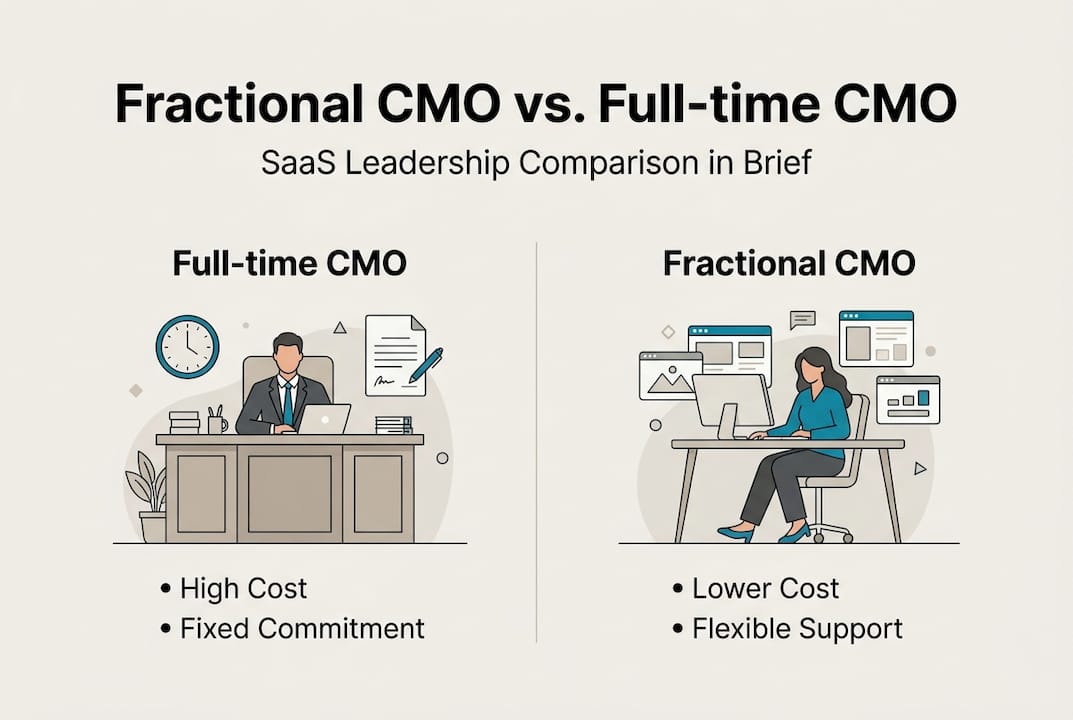
| Factor | Full-time CMO | Fractional CMO |
|---|---|---|
| Annual cost | £150,000 to £280,000+ | £40,000 to £90,000 |
| Onboarding time | 3 to 6 months | 2 to 6 weeks |
| Expertise depth | One individual’s experience | Often draws on broader network |
| Scalability | Fixed headcount | Adjustable engagement scope |
| Risk | High if wrong hire | Lower commitment, easier to pivot |
| Strategic impact | High, if experienced | High, often faster to execute |
The financial gap is significant. But the more important advantage is speed. A fractional CMO with SaaS experience has already made the expensive mistakes elsewhere. They arrive with tested frameworks, established vendor relationships, and a clear sense of what moves the needle in your specific market context.
The core benefits for SaaS businesses specifically include:
- Faster go-to-market execution: experienced fractional CMOs have launched SaaS products before and know how to compress timelines without cutting corners
- Demand-gen precision: as noted by industry practitioners, fractional CMOs with SaaS backgrounds bring sharper demand-gen messaging and positioning advantages
- Brand authenticity at scale: they help you grow without drifting from the positioning that earned your early customers’ loyalty
- Measurable revenue contribution: every activity is tied to pipeline, MRR, or CAC reduction, not vanity metrics
- Strategic agility: you can increase or reduce their involvement as your business needs evolve
If you want to boost SaaS ROI through smarter marketing investment, the fractional model offers a genuinely compelling route.
Pro Tip: Use a fractional CMO for high-stakes, time-sensitive challenges such as a product launch, a market repositioning, or entering a new vertical. These are precisely the moments where senior expertise and speed of execution matter most, and where a full-time hire would take too long to recruit and onboard.
Choosing the right fractional CMO: niche vs generalist in SaaS
Not all fractional CMOs are equal. The difference between a strong hire and a costly mistake often comes down to one question: how specific is their SaaS experience?

| Dimension | Niche fractional CMO | Generalist fractional CMO |
|---|---|---|
| Buyer language | Speaks your ICP’s language immediately | Needs time to learn your market |
| Demand-gen execution | Proven frameworks for your vertical | Generic playbooks that require adaptation |
| Credibility with team | High, earns respect quickly | Slower to establish authority |
| Time to impact | 4 to 8 weeks | 10 to 16 weeks |
| Risk of misalignment | Low | Moderate to high |
| Best suited for | Specific growth challenges | Broad brand-building phases |
The data supports the niche approach. Buyers respond better to specificity in vertical, buyer type, or problem space. A fractional CMO who has spent five years in B2B SaaS fintech will understand your compliance-conscious buyer’s objections, content preferences, and decision-making timeline far better than someone who has worked across retail, hospitality, and software in equal measure.
Here is a practical process for evaluating and engaging the right fractional CMO for your SaaS business:
- Define your specific challenge first. Are you struggling with pipeline volume, conversion rates, brand positioning, or market expansion? The answer shapes the profile you need.
- Shortlist candidates with direct vertical experience. Look for CMOs who have worked with companies at your stage, in your sector, selling to your buyer type.
- Request a positioning audit. Ask shortlisted candidates to review your current messaging and return a brief on what they would change and why. This reveals their thinking quality immediately.
- Assess cultural and values alignment. For mission-driven SaaS businesses, this is non-negotiable. A CMO who does not understand your ethical commitments will undermine them, even unintentionally.
- Agree on KPIs before engagement begins. Pipeline contribution, MQL to SQL conversion rate, CAC, and brand sentiment are all valid measures. Define them upfront.
- Start with a defined project. A 90-day sprint with clear deliverables is a lower-risk way to test the relationship before committing to a longer engagement.
SaaS founder support is most effective when it is built around your specific growth stage and market context. Generic support rarely delivers the precision that SaaS businesses need. Strong marketing leadership in this space requires both strategic vision and hands-on execution capability.
Pro Tip: During the evaluation process, ask candidates to describe a specific demand-gen campaign they led in a comparable SaaS vertical. Listen for specificity in their answer. Vague answers about “integrated strategies” and “holistic approaches” are a warning sign. Concrete numbers, clear decisions, and honest reflection on what did not work are what you want to hear.
If you want to go deeper on the fundamentals, B2B SaaS marketing explained is a useful reference for understanding the landscape your fractional CMO will be operating in.
Making the most of your fractional CMO: success factors and common pitfalls
Hiring the right fractional CMO is only half the equation. How you integrate and empower them determines whether you get transformational results or a polished strategy document that gathers digital dust.
The most successful fractional CMO engagements share several common characteristics:
- Crystal-clear KPIs from day one: both parties must agree on what success looks like before work begins, not three months in
- Direct access to the founder or CEO: fractional CMOs cannot drive change if they are filtered through layers of middle management
- A committed internal point of contact: someone on your team who can move quickly on decisions, provide data access, and facilitate introductions
- Trust-based leadership: you hired a senior expert, so give them the authority to make and implement strategic decisions
- Regular, structured communication: weekly check-ins and monthly strategy reviews keep alignment tight and prevent drift
Common pitfalls are equally worth knowing. Many SaaS businesses make the following mistakes:
- Applying a one-size-fits-all playbook: assuming that what worked for another SaaS company will work for yours without adaptation to your specific ICP, product, and market
- Slow onboarding: delaying access to data, tools, and team members costs weeks of momentum and frustrates even the most patient senior leader
- Unclear reporting lines: if the fractional CMO does not know who they report to or who reports to them, execution stalls immediately
- Treating them as a contractor rather than a leader: fractional does not mean peripheral. They should be in the room for strategic decisions, not just marketing meetings
- Ignoring the brand dimension: growth without brand coherence erodes the trust you have built with your existing customers
As the evidence consistently shows, fractional CMO positioning can have a significant impact on demand-gen results. The way your CMO frames your product in the market directly influences pipeline quality and conversion rates. Get this right and the downstream effects on revenue are substantial.
“Specificity and clear problem definition drive better outcomes — in positioning, in demand generation, and in the fractional engagement itself.”
This principle applies as much to how you brief your fractional CMO as it does to how they position your product. Clarity in, clarity out. If you want to accelerate SaaS lead generation, the quality of your strategic brief is just as important as the quality of your CMO.
Why most SaaS brands underestimate the power of niche fractional CMOs
Here is the uncomfortable truth that most hiring guides will not tell you. Many SaaS founders choose a fractional CMO based on an impressive CV and a confident pitch, rather than genuine vertical depth. They hire someone who has “worked across multiple industries” and wonder why the messaging never quite lands with their buyers.
We have seen this pattern repeatedly. The generalist CMO produces a polished strategy. The positioning sounds reasonable. But the demand-gen results are flat because the content does not resonate with the specific fears, motivations, and language of the target buyer. Credibility is earned through specificity, and as some practitioners argue, broad claims often lack the credibility that converts attention into pipeline.
Our view is straightforward. A fractional CMO with genuine SaaS battle scars in your vertical will outperform a generalist every time, even if their CV looks less varied. Look for someone who has navigated a failed product launch and learned from it. Someone who has rebuilt a positioning strategy mid-cycle because the market shifted. Someone who can tell you exactly why a specific campaign underperformed and what they changed. That depth of experience is what separates fractional CMO insights that drive real revenue from advice that sounds good in a slide deck.
Seek real-world SaaS marketing experience. Not just impressive titles.
Ready to optimise SaaS growth with a specialist?
At Media House Agency, we work with SaaS founders and decision-makers who are serious about growth without compromising their brand’s integrity. Our specialist approach to SaaS marketing strategies combines data-driven precision with the kind of strategic clarity that actually moves revenue. Whether you need fractional CMO expertise, sharper positioning, or a full go-to-market overhaul, we bring the right specialist to your challenge. Our branding and identity solutions ensure your growth never comes at the cost of your mission. If you are ready to have a direct conversation about what support for SaaS founders looks like in practice, reach out to us today.
Frequently asked questions
How quickly can a fractional CMO impact SaaS growth?
Most SaaS businesses see measurable results within the first two to three months, provided objectives are clearly defined and the CMO has direct access to data and decision-makers from the outset.
What is the main difference between a fractional and interim CMO?
A fractional CMO provides ongoing, part-time strategic leadership across a defined period, while an interim CMO is a full-time but temporary replacement, typically brought in to cover a leadership gap.
How should I measure the success of my fractional CMO?
Measure success against pre-agreed KPIs such as pipeline growth, monthly recurring revenue, customer acquisition cost, and brand positioning metrics that are specific to your SaaS product and market.
Do fractional CMOs need deep SaaS industry expertise?
Yes, strongly. Buyers respond best to leaders with specific vertical or problem space experience, which translates directly into sharper messaging, faster trust-building, and stronger demand-gen performance.