
TL;DR:
- Growth marketing emphasizes experimentation, full-funnel thinking, and continuous measurement to drive sustainable growth.
- It relies on frameworks like AARRR and ICE scoring to optimize the entire customer journey.
- Successful growth requires cross-functional teams, disciplined prioritization, and a focus on long-term brand integrity.
Most founders assume growth marketing is simply digital marketing with a fancier name. It is not. Growth marketing is a fundamentally different discipline, one built on experimentation, full-funnel thinking, and relentless measurement. For luxury brands and ethical scale-ups, this distinction is not academic. It determines whether your marketing budget compounds into a competitive advantage or quietly drains away on campaigns that look impressive but deliver little. The leaders who understand this difference are the ones pulling ahead. Those still running one-off campaigns and measuring success by reach alone are falling further behind with every quarter.
Table of Contents
- What is growth marketing? Defining the differences
- Key frameworks and methodologies powering growth
- Core processes for sustainable, scalable growth
- Benchmarks, case studies, and evidence of impact
- Common pitfalls and how the best teams win
- What most guides miss: The uncomfortable truths of growth marketing
- Ready to drive measurable growth?
- Frequently asked questions
Key Takeaways
| Point | Details |
|---|---|
| Lifecycle optimisation | Growth marketing improves every stage of the customer journey, not just acquisition or awareness. |
| Data-driven frameworks | Frameworks like AARRR and continuous experimentation underpin scalable, repeatable brand growth. |
| Real-world ROI | Growth marketing consistently delivers measurable improvements in return on investment, conversion rates, and customer lifetime value. |
| Sustainable, not just trendy | Unlike one-off campaigns, growth marketing creates persistent, compounding value for luxury and ethical brands. |
What is growth marketing? Defining the differences
Growth marketing is not a trend. It is a discipline with a precise definition and a clear methodology. Growth marketing is a data-driven approach that applies the scientific method to optimise the entire customer lifecycle for sustainable business growth, contrasting directly with traditional marketing’s focus on brand awareness and one-off campaigns.
Traditional marketing asks: how do we get more people to notice us? Growth marketing asks: how do we turn attention into revenue, and revenue into loyalty, systematically?
The contrast matters enormously for luxury and values-driven brands. Your customers are not impulse buyers. They research, compare, and expect a coherent experience from first touch to repeat purchase. A single campaign cannot deliver that. A lifecycle approach can.
Here is how the two models compare:
| Dimension | Traditional marketing | Growth marketing |
|---|---|---|
| Primary objective | Brand awareness | Full-funnel revenue growth |
| Measurement | Reach, impressions | CAC, LTV, ROAS, retention |
| Approach | Campaign-based | Continuous experimentation |
| Scope | Top of funnel | Entire customer lifecycle |
| Speed of learning | Slow (quarterly reviews) | Fast (weekly iterations) |
For SaaS founders and luxury brand leaders, the lifecycle approach is not optional. It is the only model that produces compounding returns. Every experiment you run adds to a body of knowledge about your customer. That knowledge becomes a strategic asset your competitors cannot easily replicate.
“Growth marketing applies the scientific method to the entire customer lifecycle, moving well beyond awareness to drive sustainable, measurable business outcomes.” — GrowthMethod
This is the foundation. Everything else builds on it.
Key frameworks and methodologies powering growth
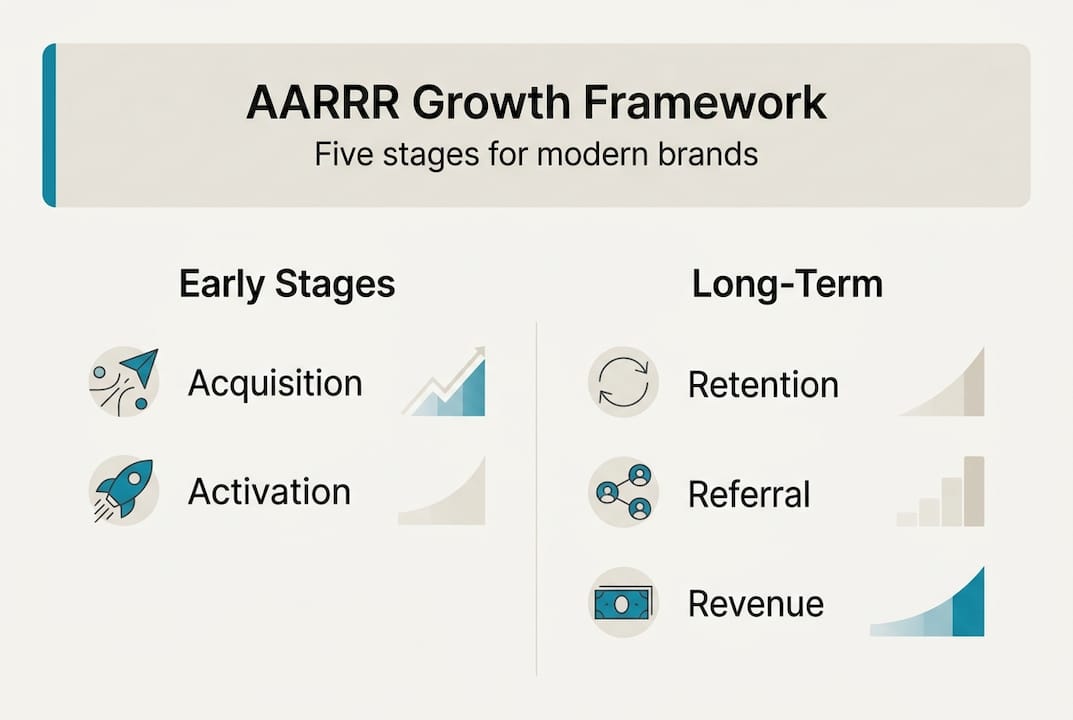
Frameworks give growth marketing its structure. Without them, experimentation becomes guesswork. The most widely used and proven framework is AARRR, also known as the pirate metrics.
Core methodologies include the AARRR framework covering Acquisition, Activation, Retention, Revenue, and Referral, alongside hypothesis-driven experimentation, growth modelling, and continuous prioritisation using ICE scoring.
Here is what each stage means in practice:
- Acquisition: How customers first find you, paid, organic, referral, or social
- Activation: The moment a customer experiences real value for the first time
- Retention: Whether customers return, and how often
- Revenue: How effectively you monetise your existing base
- Referral: Whether satisfied customers bring others to you
ICE scoring, which stands for Impact, Confidence, and Ease, is how growth teams decide which experiments to run first. Each idea is scored across these three dimensions and ranked. The highest-scoring experiments get prioritised. It sounds simple, and it is. That simplicity is exactly why it works.
| Experiment idea | Impact (1-10) | Confidence (1-10) | Ease (1-10) | ICE score |
|---|---|---|---|---|
| Onboarding email sequence | 8 | 7 | 6 | 7.0 |
| Referral programme | 9 | 6 | 5 | 6.7 |
| Checkout page optimisation | 7 | 8 | 8 | 7.7 |
When working with customer journey data strategies, the AARRR model becomes a diagnostic tool. You can identify precisely where customers are dropping off and direct your experiments accordingly.
Pro Tip: Most brands over-invest in acquisition and under-invest in retention. Improving retention by just 5% can increase profitability by 25% to 95%, according to Bain and Company research. Audit your retention metrics before spending another pound on acquisition.
Core processes for sustainable, scalable growth
Frameworks tell you what to measure. Processes tell you how to act on it. Growth marketing in practice follows a clear, repeatable sequence.

Key processes include setting goals and KPIs, researching customer insights, prioritising experiments, running A/B tests, analysing results, building scalable flywheels, and iterating rapidly.
Here is how this looks step by step:
- Set your North Star metric. This is the single number that best represents the value your business delivers to customers. Everything else flows from it.
- Research deeply. Use customer interviews, session recordings, and analytics to understand where friction exists.
- Generate hypotheses. Each experiment should have a clear hypothesis: if we change X, we expect Y because of Z.
- Prioritise using ICE. Score every hypothesis and run the highest-value experiments first.
- Run controlled tests. A/B and multivariate tests isolate variables so you know exactly what caused a change in results.
- Analyse and document. Every result, positive or negative, adds to your knowledge base.
- Scale what works. Winning experiments become standard practice. Losing ones inform the next hypothesis.
- Repeat. Growth is not a project. It is an operating rhythm.
Building data-driven marketing plans around this process ensures your team is always working on the highest-leverage activities. It also makes optimising your marketing workflow a natural outcome rather than an afterthought.
Pro Tip: Define your North Star metric before you run a single experiment. Without it, every result is ambiguous. With it, every decision has a clear reference point.
Benchmarks, case studies, and evidence of impact
Data is only persuasive when it is specific. Here is what growth marketing actually delivers when applied rigorously.
Empirical benchmarks from e-commerce and DTC brands show email ROI of £36 to £42 per £1 spent at the top end reaching £70 or more, overall DTC ROAS averaging 3.2x with the top 10% achieving 6.4x, and average customer acquisition costs in beauty and fashion sitting at £38.50 with top performers at £21.80.
These are not outliers. They are the result of systematic growth marketing applied consistently over time.
The Pip Pop Post jewellery case is particularly instructive for luxury and premium brands. By applying performance-led growth marketing, the brand achieved 6x ROAS, 14x conversion volume, and an 83% improvement in cost per acquisition on a 133% increase in spend. More spend, dramatically better efficiency.
What does this tell us? A few things worth noting:
- Scale amplifies efficiency when the underlying system is sound
- Premium products can achieve elite ROAS with the right targeting and creative alignment
- CPA improvement is possible even as budgets grow, which contradicts the common assumption that scaling always increases acquisition costs
- Conversion volume growth matters as much as efficiency metrics for founders focused on revenue
For SaaS marketing success and luxury brand leaders, these benchmarks serve as a calibration tool. If your current ROAS sits well below 3.2x, there is a clear gap to close. If your email programme is not generating meaningful ROI, it is a lever you are not pulling.
Evidence matters. It replaces gut instinct with direction.
Common pitfalls and how the best teams win
Growth marketing fails more often than most guides admit. Understanding why is as valuable as understanding the frameworks themselves.
Excellent growth teams obsess over user friction across entire journeys, own outcomes end-to-end, and use AI for execution while humans set direction. Teams that fail typically operate in silos or chase vanity metrics.
Here are the most common pitfalls we see:
- Siloed functions. When marketing, product, and data teams do not share goals, experiments produce conflicting signals and no one owns the outcome.
- Vanity metrics. Follower counts and impressions feel good but do not pay salaries. If your reporting does not connect to revenue, it is decorative.
- Skipping activation. Many teams focus entirely on acquisition and wonder why churn is high. If customers do not experience value quickly, they leave.
- Inconsistent experimentation. Running one test per quarter is not growth marketing. It is occasional testing. The cadence matters as much as the method.
- Over-reliance on tactics. Copying a competitor’s campaign without understanding the underlying strategy rarely works. Context is everything.
The best teams operate differently. They are cross-functional by design. They measure what matters and ignore what does not. They use AI for B2B growth to accelerate execution while keeping strategic decisions with experienced humans.
“Excellent growth teams see what others miss because they own the full journey, not just their slice of it.” — Lenny’s Newsletter
Applying advanced digital marketing approaches within this team structure is what separates consistent performers from occasional winners.
What most guides miss: The uncomfortable truths of growth marketing
Most guides on growth marketing read like instruction manuals. They explain the frameworks, list the tools, and send you on your way. What they rarely say is this: growth marketing is a long game, and most organisations are not structurally ready for it.
For luxury and ethical scale-ups, the playbooks built for SaaS or mass-market e-commerce do not translate directly. Your customer relationships are more nuanced. Your brand carries weight that cannot be sacrificed for a short-term conversion lift. The discipline required is not just analytical. It is editorial. You must say no to experiments that would compromise brand integrity, even if the data suggests a short-term gain.
The real work of growth marketing is prioritisation. Not launching more tactics, but ruthlessly focusing on the few experiments most likely to move your North Star metric. That requires confidence, not just capability.
Invest in building the learning infrastructure before you invest in the tactics. Teams that understand AI-enhanced marketing workflows and use them to accelerate learning cycles will compound their advantage faster than those still running quarterly campaigns.
Pro Tip: Before adopting any growth framework, audit your data infrastructure. If you cannot measure it accurately, you cannot improve it reliably.
Ready to drive measurable growth?
Growth marketing is not a service you bolt on. It is a strategic operating model. For founders and marketing leaders who are serious about sustainable, measurable results, the frameworks and processes in this guide are your starting point, not your finish line.
At Media House Agency, we bring SaaS marketing strategies and Silicon Valley-grade analytical rigour to luxury brands, ethical scale-ups, and visionary founders. We build growth systems that compound. If you are ready to move beyond campaign thinking, explore our digital marketing tips or speak directly with our team about a strategic partnership. Our digital marketing services are built for leaders who demand performance without compromising what their brand stands for.
Frequently asked questions
How does growth marketing improve on traditional marketing for luxury brands?
Growth marketing optimises every stage of your customer’s journey using experimentation and data, delivering measurable, compounding ROI that one-off campaigns simply cannot match, which is especially critical for premium and values-driven brands.
What makes the AARRR framework important for ethical scale-ups?
The AARRR framework enables ethical scale-ups to focus on activation, retention, and referrals rather than short-term acquisition alone, powering long-term sustainable growth that aligns with brand values.
What types of experiments do growth marketers typically run?
Growth marketers run A/B and multivariate tests throughout the customer lifecycle, optimising elements like copy, offers, and user journeys based on analytics to improve conversion and retention.
Are there proven results for growth marketing in e-commerce and luxury?
Yes. Benchmarks show email ROI of £36 to £42 per £1 spent and DTC ROAS averaging 3.2x, with top performers in beauty and fashion achieving dramatically lower customer acquisition costs through systematic growth marketing.