
Most SaaS marketers are chasing rankings when they should be building trust. Search visibility matters, but it rarely closes deals on its own. The real conversion work happens when a prospect reads something that speaks directly to their problem, walks them through a credible solution, and connects that solution to your product. That is exactly what a well-built guide does. Yet most teams still treat guides as glorified blog posts, stuffed with keywords and light on substance. This article breaks down why guides are one of the most powerful assets in SaaS marketing, what separates high-converting guides from forgettable ones, and how to use them strategically across your entire buyer journey.
Table of Contents
- Why guides are central to SaaS marketing success
- Inside a high-converting SaaS guide: Essential elements and frameworks
- What most guides get wrong (and how to fix it)
- Advanced perspectives: AI, sales integration, and the future role of guides
- A contrarian take: Why guides require sales intent, not just SEO polish
- Scale your SaaS marketing impact with proven guide frameworks
- Frequently asked questions
Key Takeaways
| Point | Details |
|---|---|
| Guides build trust | SaaS guides educate and convert prospects by solving real buyer problems and showing proof. |
| Sales-first beats SEO-only | Guides that prioritise sales intent, CTAs, and ICP relevance outperform those built just for search engines. |
| Always update guides | Review and refresh your guides every 6–9 months to stay relevant and credible in fast-moving SaaS industries. |
| AI raises the bar | In the era of AI and LLMs, expert-backed, actionable guides are key to standing out from generic or thin content. |
| Structure drives results | Clear frameworks, targeted messaging, and ongoing optimisation are essential for high-performing SaaS guides. |
Why guides are central to SaaS marketing success
The SaaS buying process is rarely quick. Prospects research, compare, doubt, and revisit before they ever speak to sales. Generic SEO content can attract traffic, but it rarely does the heavy lifting of moving someone from curious to convinced. That is where guides earn their place.
Guides such as “Ultimate Guides” play a central role in SaaS content marketing by educating prospects, building customer trust in SaaS marketing, and driving conversions across the buyer journey. They do not just inform. They build the credibility that makes a buyer feel safe enough to act.
Think about what a strong guide actually achieves compared to a standard SEO article. A blog post might answer one question. A guide answers a cluster of connected questions, addresses objections, and positions your product as the logical next step. That is a fundamentally different asset.
Here is what well-constructed guides consistently deliver:
- Educate prospects at the awareness and consideration stages, reducing sales friction
- Build E-E-A-T signals (Experience, Expertise, Authoritativeness, Trustworthiness) that search engines and readers both reward
- Trigger action by connecting problem awareness to product-led solutions
- Support sales teams with shareable, credible assets that reinforce conversations
- Serve multiple touchpoints, from organic search to email nurture to sales follow-up
“Guides are not just content. They are the bridge between a prospect’s problem and your product’s promise. Without that bridge, you are just producing noise.”
The buyer journey context matters here. A prospect in the awareness stage needs education. One in the consideration stage needs proof. A guide built correctly can serve both, because it layers information progressively. You start with the problem, build stakes, introduce the solution, and demonstrate product relevance. That structure is what separates a guide that converts from one that just ranks. Explore how this connects to SaaS conversion strategy to see the full picture.
Inside a high-converting SaaS guide: Essential elements and frameworks
Knowing that guides matter is one thing. Building one that actually works is another. The mechanics are specific, and getting them right requires more than good writing.
Effective SaaS guides are built around ICP-specific targeting, a clear problem-to-product structure, contextual calls to action, and a regular refresh cycle every 6 to 9 months. Each of these elements plays a distinct role. Skip one and the guide loses its edge.

Here is how a basic SEO guide compares to a sales-driven SaaS guide:
| Element | SEO-focused guide | Sales-driven SaaS guide |
|---|---|---|
| Target audience | Broad keyword match | Specific ICP with defined pain points |
| Structure | Topic coverage | Problem, stakes, promise, product bridge |
| Depth | Surface-level answers | Detailed, practitioner-level insight |
| CTAs | Generic or absent | Contextual, tied to reader’s next step |
| Outcome | Traffic | Pipeline and conversions |
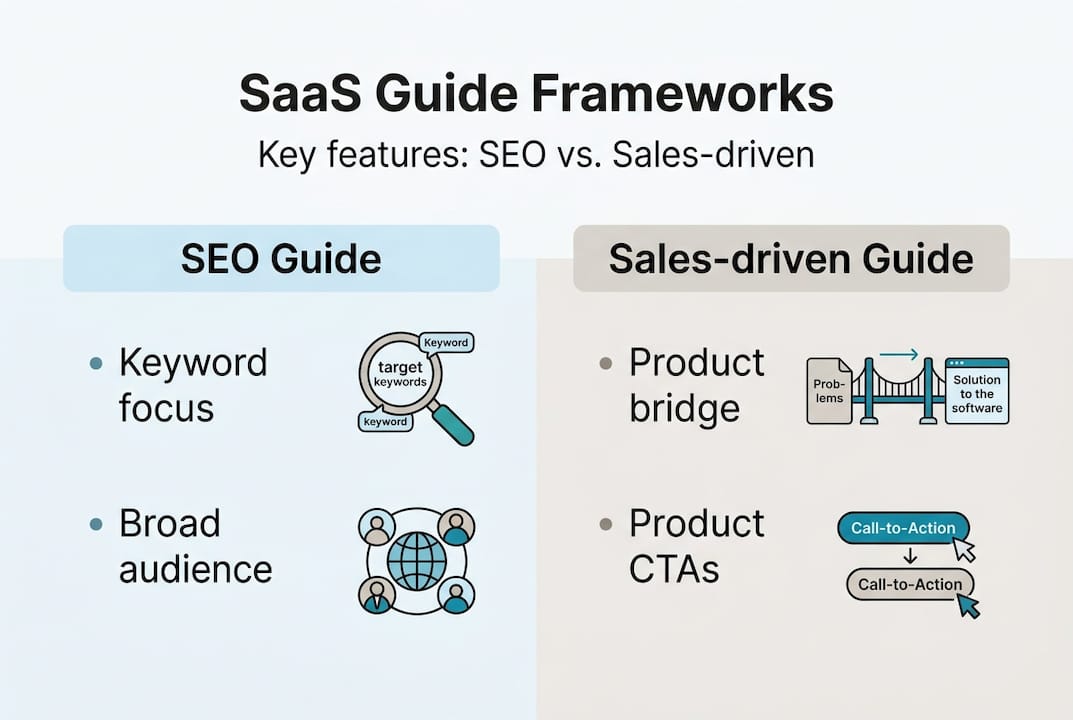
The difference is stark. One is built for algorithms. The other is built for buyers.
To build a guide that converts, follow this sequence:
- Define your ICP with precision. Who is this for, what do they fear, and what does success look like for them?
- Frame the problem in language your ICP actually uses. Mirror their vocabulary, not yours.
- Raise the stakes by showing what happens if the problem goes unsolved. Make the cost of inaction tangible.
- Demonstrate value through frameworks, data, and real-world examples that prove your understanding.
- Introduce product proof naturally. Show how your solution resolves the specific problem you have been discussing.
- Integrate CTAs at logical decision points, not just at the end. Contextual CTAs convert far better than footer links.
Pro Tip: Use screenshots and real-user quotes as mini-tutorials within your guide. They add credibility, break up dense text, and show rather than tell. Readers trust what they can see.
Refresh cycles are often overlooked. A guide published 18 months ago with outdated statistics or obsolete product references actively damages trust. Build a review schedule into your content calendar. This is a core part of content marketing for SaaS brands that most teams skip. For broader distribution thinking, B2B content syndication can extend the reach of your best guide assets significantly.
What most guides get wrong (and how to fix it)
Most SaaS guides fail not because they are badly written, but because they are built for the wrong goal. When SEO is the only objective, the guide ends up targeting everyone and converting no one.
SEO-focused guides fail without sales intent. They lack a product bridge, carry weak CTAs, and rely on data that goes stale. The result is traffic without pipeline. That is a costly mistake in a SaaS environment where customer acquisition costs are high.
Here is how the two approaches compare in practice:
| Failing guide trait | High-impact guide feature |
|---|---|
| Generic title targeting broad keywords | ICP-specific title addressing a real pain point |
| No clear product connection | Explicit product bridge tied to the problem |
| Single CTA at the end | Contextual CTAs throughout |
| Data older than 12 months | Fresh statistics with clear sourcing |
| No E-E-A-T signals | Author credentials, case studies, user proof |
The fixes are actionable. Here are seven you can apply immediately:
- Rewrite the title to speak directly to your ICP’s specific challenge
- Add a value bridge that connects the guide’s core insight to your product’s unique capability
- Restructure using the problem, stakes, promise, product framework
- Address objections explicitly. If buyers hesitate, your guide should handle that hesitation
- Place CTAs at the moment of highest relevance, not just at the bottom
- Set a refresh schedule and treat it as non-negotiable, not optional
- Show win scenarios using real customer outcomes, not hypothetical benefits
Pro Tip: Score your top three competitors’ guides against a basic checklist: ICP clarity, product bridge, CTA placement, data freshness, and E-E-A-T signals. You will quickly see where the gap is and where you can win. Use this as input for your SaaS conversion improvements.
Practitioners who update guides with real buyer context and fresh proof consistently see stronger engagement and better pipeline attribution. It is not about volume. It is about relevance. For further context on advanced SaaS marketing strategy, the principle holds: depth and intent beat breadth every time.
Advanced perspectives: AI, sales integration, and the future role of guides
The content landscape is shifting fast. AI tools can now generate passable SEO articles in minutes. That changes the game for SaaS marketers. If your guide reads like something a language model could produce without context, it will not build trust. It will blend into the noise.
The AI and LLM shift favours comprehensive, expert-backed guides over thin content. Search engines are getting better at distinguishing genuine expertise from recycled information. Buyers are too.
Expert-backed guides deliver trust in an AI-saturated market by doing things AI alone cannot:
- Drawing on practitioner experience that is specific, verifiable, and grounded in real outcomes
- Incorporating customer language gathered from actual conversations, not keyword tools
- Demonstrating product understanding at a depth that only comes from working with the product daily
- Showing editorial judgement, choosing what to include and what to leave out based on buyer need
“Guides built with genuine expertise and sales alignment are becoming the primary trust signal in a market flooded with AI-generated content. Thin content is now a liability, not a shortcut.”
Not every SaaS business needs guides in the same way. Inbound and SEO-driven SaaS brands rely on guides heavily for discovery and credibility. Product-led growth companies and high-touch enterprise sellers may use them differently, as sales enablement tools or onboarding resources rather than top-of-funnel content. The format adapts, but the principle stays the same: guides must earn trust and move buyers forward.
Frequent refresh and sales alignment are what keep guides relevant as buyer behaviour evolves. Pair this with AI-enhanced SaaS marketing workflows to maintain quality at scale. And if you are looking to connect guide performance to broader revenue goals, SaaS ROI strategies offer a useful framework for measurement.
A contrarian take: Why guides require sales intent, not just SEO polish
Here is the uncomfortable truth most content teams avoid: publishing more guides does not automatically create more pipeline. We see this pattern repeatedly. A SaaS brand invests in six new guides in a quarter, traffic ticks up, and conversions barely move. The volume was there. The intent was not.
In our experience, the only guides that drive real pipeline are those built with direct sales alignment, fresh proof, and ICP-specific language from the first sentence. Everything else is content for content’s sake.
The surprising lesson? Refreshing or repurposing one well-chosen guide often outperforms creating five new undifferentiated pieces. A single guide updated with current data, sharper CTAs, and real customer outcomes can generate more qualified leads than a full content sprint.
Every great guide is a sales asset, not just another SEO play.
If you are serious about content marketing for SaaS, start by auditing what you already have. Find the guide closest to your ICP’s core problem and rebuild it with sales intent. That single move will do more for your pipeline than most new content ever will. Building SaaS customer trust starts with content that earns it, not content that merely exists.
Scale your SaaS marketing impact with proven guide frameworks
If this article has made one thing clear, it is that guides are not a content checkbox. They are strategic assets that require intent, structure, and ongoing investment to deliver real results. At Media House Agency, we work with SaaS founders and marketing leaders to build guide-driven frameworks that convert attention into pipeline.
Whether you are looking to improve your SaaS marketing strategies, boost SaaS conversions through better content, or access advanced digital marketing expertise, we bring the analytical rigour and strategic clarity your growth demands. Let us help you build guides that do not just rank, but sell.
Frequently asked questions
What makes a SaaS guide effective in driving conversions?
A SaaS guide works when it targets a specific ICP, walks prospects through real problems, and uses proof and clear CTAs to nudge action. Guides drive conversions most effectively when they are built as sales assets, not just informational resources.
How often should SaaS guides be updated?
Effective SaaS guides are typically reviewed and refreshed every 6 to 9 months to ensure they remain relevant and credible. Regular refresh cycles are a core mechanic of high-performing guide strategy.
Are guides still important with the rise of AI and PLG?
Guides remain vital for inbound, SEO, and credibility even as AI changes discovery and PLG shifts sales dynamics. The AI and LLM shift actually increases the value of expert-backed guides over thin, generic content.
What are common mistakes with SaaS guides?
The most common mistakes are generic SEO focus, neglecting sales integration, lacking proof, and failing to refresh content regularly. SEO-focused guides fail without sales intent and a clear product bridge connecting the content to buyer action.