TL;DR:
- Clear, targeted messaging around prospect pain points increases demo request relevance and conversion.
- Optimizing call-to-action wording and simplifying booking flows dramatically boost demo sign-ups.
- Focusing on channels where your ideal customers are active and leveraging customer advocates yields higher quality demos.
You are spending on paid campaigns, publishing content, and driving traffic to your site. Yet demo request numbers remain stubbornly low. This is one of the most common frustrations for SaaS marketing leaders and founders, and it signals something deeper than a budget problem. Demo requests are a direct measure of qualified pipeline health. Every missed booking is a missed revenue opportunity. This guide covers five practical, evidence-backed strategies to close the gap between visitor interest and booked demos, so you can build a more predictable, higher-quality sales pipeline without simply spending more.
Table of Contents
- Clarify your ideal customer and demo value
- Optimise your CTAs and demo booking flow
- Leverage the right channels: where your customers spend time
- Accelerate demo requests with post-click nurturing and personalisation
- What most SaaS leaders miss about demo requests
- Level up your SaaS demo acquisition with proven marketing partners
- Frequently asked questions
Key Takeaways
| Point | Details |
|---|---|
| Know your audience | Defining the ideal customer unlocks higher quality and more SaaS demo requests. |
| Refine your CTAs | Simple language changes can dramatically boost demo conversions on your site. |
| Prioritise high-impact channels | Focus your outreach on platforms where your best prospects actually engage. |
| Nurture every lead | Personal follow-up and segmentation turn interest into completed demo bookings. |
Clarify your ideal customer and demo value
The single biggest reason demo requests underperform is not a traffic problem. It is a relevance problem. If your messaging speaks to everyone, it resonates with no one. Before you optimise buttons or booking flows, you need absolute clarity on who your demo is for and why it matters to them specifically.
Start by tightening your Ideal Customer Profile (ICP). An ICP is a detailed description of the specific company type, role, and situation that gets the most value from your product. The more precise your ICP, the more targeted your outreach and messaging becomes, and the more likely the right people will raise their hand for a demo.
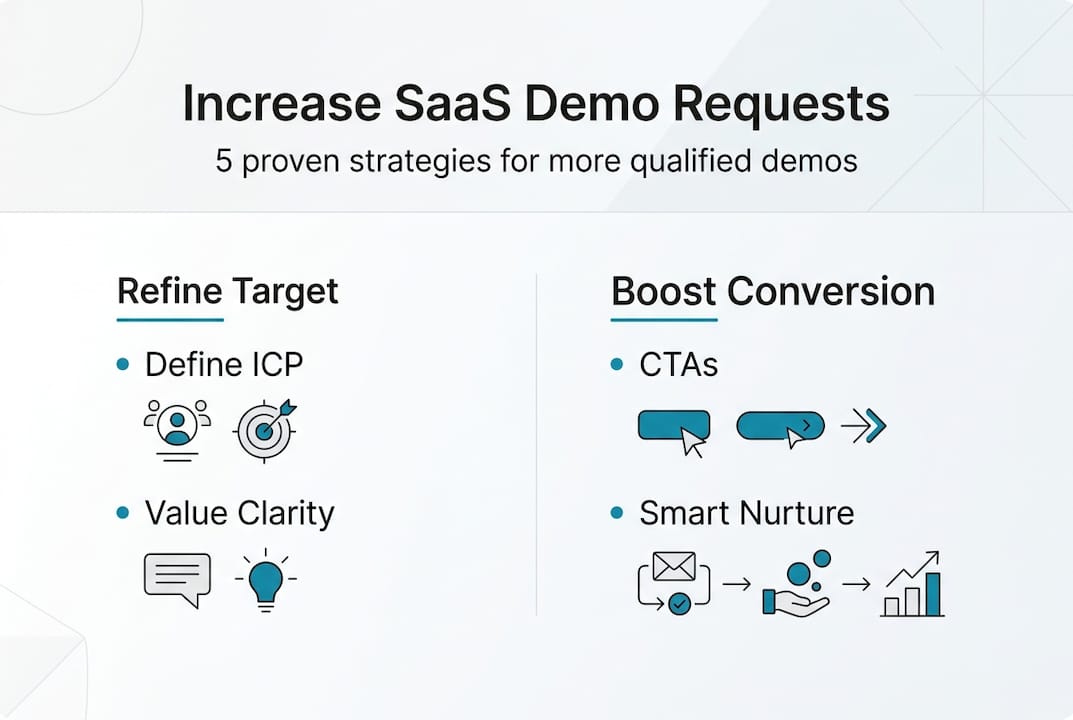
Once you know who you are speaking to, build your demo messaging around their pain points, not your features. Your prospects are not interested in your product roadmap. They are interested in solving a specific problem faster or cheaper. Frame your demo invitation around that outcome.
Key elements of strong demo value messaging:
- Lead with the problem your prospect is actively experiencing
- State the outcome they can expect from attending the demo
- Use language your ICP uses in job posts, reviews, and community discussions
- Keep it specific to industry, role, or use case where possible
- Remove vague claims like ‘all-in-one solution’ or ‘enterprise-ready platform’
Broad paid campaigns rarely outperform targeted, customer-centric outreach. As SaaStr highlights, customer advocates are worth 10x paid campaigns when you show up where your customers already are. That insight applies equally to how you position your demo invitation.
Pro Tip: Interview three to five of your best existing customers. Ask them what almost stopped them from booking a demo and what finally convinced them. Use their exact words in your CTA copy and demo landing page. This one tactic can dramatically boost SaaS conversions without increasing ad spend.
Optimise your CTAs and demo booking flow
With a clear audience and compelling value proposition, your next priority is the mechanics of the booking journey itself. Even the strongest messaging will fail if the path to booking is clunky, confusing, or unconvincing.
CTA wording has an outsized impact on conversion rates. The language you choose signals what the prospect will experience and how much effort it will take. Research from Martin Greif on LinkedIn shows that changing a CTA button from ‘Request Demo’ to ‘Speak with Expert’ increased conversions from 8% to 40%. That is not a minor uplift. That is a transformation.
| CTA version | Implied effort | Conversion signal |
|---|---|---|
| Request Demo | High, formal process | Low intent, uncertain outcome |
| Book a Demo | Moderate, calendar-based | Clear but impersonal |
| Speak with Expert | Low, conversational | Personal, high value |
| See It in Action | Low, exploratory | Curious, lower barrier |
Beyond wording, the booking form itself is a conversion lever. Every additional field you ask prospects to complete increases drop-off. Aim for the minimum viable information: name, work email, company name, and a brief note on their challenge.
Here is a straightforward process for auditing and improving your demo booking flow:
- Map the full journey from ad or page visit to confirmed booking confirmation
- Count every click and field a prospect must complete
- Remove any step that does not directly serve booking quality
- Test CTA wording on your highest-traffic pages first
- Add social proof near the CTA (customer logos, review snippets, or a short testimonial)
Placement matters too. Do not limit your CTA to the hero section. Repeat it at logical decision points throughout your page, including mid-page after a key benefit and at the bottom before the footer. Well-structured high-converting landing pages consistently use this repetition to catch prospects at different stages of readiness.
Pro Tip: Use a scheduling tool like Calendly embedded directly in your landing page to eliminate the back-and-forth email exchange. Reducing steps between intent and confirmed booking is one of the fastest ways to improve SaaS conversion rates.
Leverage the right channels: where your customers spend time
Optimising your booking flow is vital, but it only works if the right people are reaching your page in the first place. Channel selection is where many SaaS teams waste significant budget by spreading too thin across every possible platform.
The most effective approach is ruthless prioritisation. Identify where your ICP is already active and focus your energy there. For most B2B SaaS products, a small number of channels deliver the majority of quality demo requests.
| Channel | Best for | Typical buyer behaviour |
|---|---|---|
| Mid-market and enterprise SaaS | Research, peer validation, outreach | |
| B2B communities (Slack, Reddit) | SMB and founder-led SaaS | Peer recommendations, reviews |
| Industry events and webinars | All segments | High-trust, high-intent engagement |
| G2 and Capterra | High-intent comparison shoppers | Bottom-of-funnel, ready to decide |
As SaaStr notes, showing up where your customers already are is 10x more effective than broad paid campaigns. This is not about abandoning paid channels entirely. It is about making sure your organic presence, community engagement, and channel mix are actually aligned with your buyers’ habits.
Focus does not mean doing less. It means doing the right things in the right places with enough consistency to build trust over time.
Customer advocates and case studies are particularly powerful channel amplifiers. A customer sharing their success story in a relevant Slack community or LinkedIn post carries more weight than any ad. Invest in making it easy for your happiest customers to talk about you.
For teams investing in content and video, SaaS-specific video marketing can significantly increase demo request rates when used to demonstrate real product value in 60 to 90 seconds. Pair that with well-targeted SaaS marketing strategies for each channel and your cost per demo request will drop.
Accelerate demo requests with post-click nurturing and personalisation
Once you are visible in the right places and capturing interest, the next challenge is converting that interest into actual booked demos. This is where nurturing and personalisation make a measurable difference.

The speed and relevance of your follow-up is critical. A lead who fills in a ‘learn more’ form and hears nothing for 48 hours is already cooling. Research consistently shows that responding within the first hour of a prospect’s action increases the likelihood of engagement significantly.
Effective post-click nurturing tactics:
- Trigger personalised emails immediately after a form fill, gated content download, or pricing page visit
- Reference the specific action they took to show attentiveness, not generic automation
- Segment by role and pain point so your follow-up speaks to what matters most to that buyer type
- Use LinkedIn connection requests from the sales rep within 24 hours for higher-value accounts
- Create a short nurture sequence of three to five emails over two weeks before considering a lead cold
Personalisation here does not mean using someone’s first name. It means tailoring the message to their role, the problem they are likely facing, and where they are in their buying journey. As SaaStr points out, customer advocates amplify results, reinforcing the impact of thoughtful nurturing beyond just initial acquisition. The same principle applies post-click: relevance builds trust, and trust books demos.
For teams with multiple segments or account types, account-based approaches sharpen this further. Investing in a well-structured approach to optimise your SaaS customer journey ensures leads do not fall through the cracks. Combining that with SaaS ABM strategies allows you to concentrate your best nurturing effort on the accounts most likely to convert.
Pro Tip: Build a simple lead scoring system. Assign points to behaviours like pricing page visits, repeated site sessions, or content downloads. Route high-scoring leads to direct outreach immediately rather than an automated sequence. Prioritising fit and speed will consistently outperform volume.
What most SaaS leaders miss about demo requests
Here is something we see consistently: teams obsess over growth tactics while ignoring the fundamentals of fit and friction. They chase the next channel, the latest automation tool, or a new ad format, when the actual problem is that they are trying to convert people who were never going to book a demo anyway.
The highest-performing SaaS teams we work with do something counterintuitive. They actively reduce demo request volume to increase quality. They tighten targeting, simplify the booking path, and focus energy on a smaller number of genuinely well-matched prospects. The result is a shorter sales cycle, higher close rates, and a sales team that is not wasting time on poor-fit leads.
Over-automation is another hidden conversion killer. When every touchpoint feels templated and impersonal, trust erodes. Prospects can tell. A well-timed, specific message from a real person will outperform a 12-step automated sequence almost every time for high-value accounts.
The goal is not more demos. It is more of the right demos. That distinction is the foundation of mastering SaaS lead generation in a way that actually scales.
Level up your SaaS demo acquisition with proven marketing partners
Getting more demo requests is rarely about a single tactic. It is about aligning your ICP targeting, messaging, channel mix, booking flow, and nurturing into a coherent system. That takes time, expertise, and consistent iteration. If you are serious about accelerating results, working with specialists who understand the SaaS funnel can compress your learning curve considerably.
At Media House Agency, we help SaaS founders and marketing leaders build demand generation engines that convert. Whether you need a sharper SaaS marketing strategy, a data-driven SaaS marketing plan, or direct support to boost SaaS demo conversions, we bring the precision and experience to make it happen without the agency bloat.
Frequently asked questions
What is the best CTA to increase SaaS demo requests?
CTAs like ‘Speak with Expert’ and ‘Book a Demo’ consistently outperform ‘Request Demo’, with one case study showing conversion rates jumping from 8% to 40% after a simple wording change.
How important are customer advocates for SaaS demo growth?
Customer advocates can generate 10 times the impact of paid campaigns, making them one of the most cost-effective drivers of quality demo requests for SaaS businesses.
Which channels work best for promoting SaaS demos?
LinkedIn, customer communities, and industry events are consistently top performers. The key is focusing on channels where your specific ICP is already active rather than spreading budget across every platform.
How can I reduce friction in my demo request process?
Streamline your booking form to the minimum required fields and embed a scheduling tool directly on your landing page. Clearer CTA language and fewer steps significantly reduce drop-off between intent and confirmed booking.