

TL;DR:
- Emotional storytelling influences B2B buyers’ decisions by building trust and creating memorable content. Most companies fail by centering their brand rather than the buyer’s journey, weakening emotional connection. Aligning storytelling across teams and embedding it into sales and marketing operations drives measurable pipeline growth.
B2B buyers are not the purely rational decision-makers we once assumed. The reality is that emotion shapes how they evaluate, remember, and choose. Understanding why storytelling in B2B matters is not a soft marketing concern; it is a revenue question. Storytelling boosts conversion rates by 30%, moving prospects from passive reading to active evaluation. Yet most B2B brands still rely on feature lists, ROI calculators, and product demos to do the heavy lifting. This article breaks down what the data says, where most teams go wrong, and how to build a storytelling approach that actually drives pipeline.
Table of Contents
- How B2B buyers rely on storytelling during their journey
- The structural pitfalls of typical B2B storytelling and how to fix them
- Measuring storytelling impact: conversion and pipeline metrics that matter
- Aligning storytelling across sales, marketing and customer success
- How to craft a compelling data-backed B2B storytelling strategy
- Why many B2B storytelling efforts fail and how to get it right
- Boost your B2B growth with strategic storytelling solutions
- Frequently asked questions
Key Takeaways
| Point | Details |
|---|---|
| Storytelling drives emotional connection | B2B buyers make decisions emotionally first, so storytelling builds trust beyond features. |
| Buyers research independently | Effective stories influence buyers during the majority of their purchase research before sales contact. |
| Structure stories around buyers | Place the customer as the hero and brand as guide to increase engagement and memorability. |
| Data validates narratives | Incorporating specific metrics and named sources boosts story credibility and conversion rates. |
| Align teams with one story | Unified narratives across sales, marketing, and success enhance buyer trust and retention. |
How B2B buyers rely on storytelling during their journey
The buying process has changed fundamentally. Your prospects are not waiting for a sales call to learn about your category. They are reading, comparing, and forming opinions long before anyone picks up the phone.
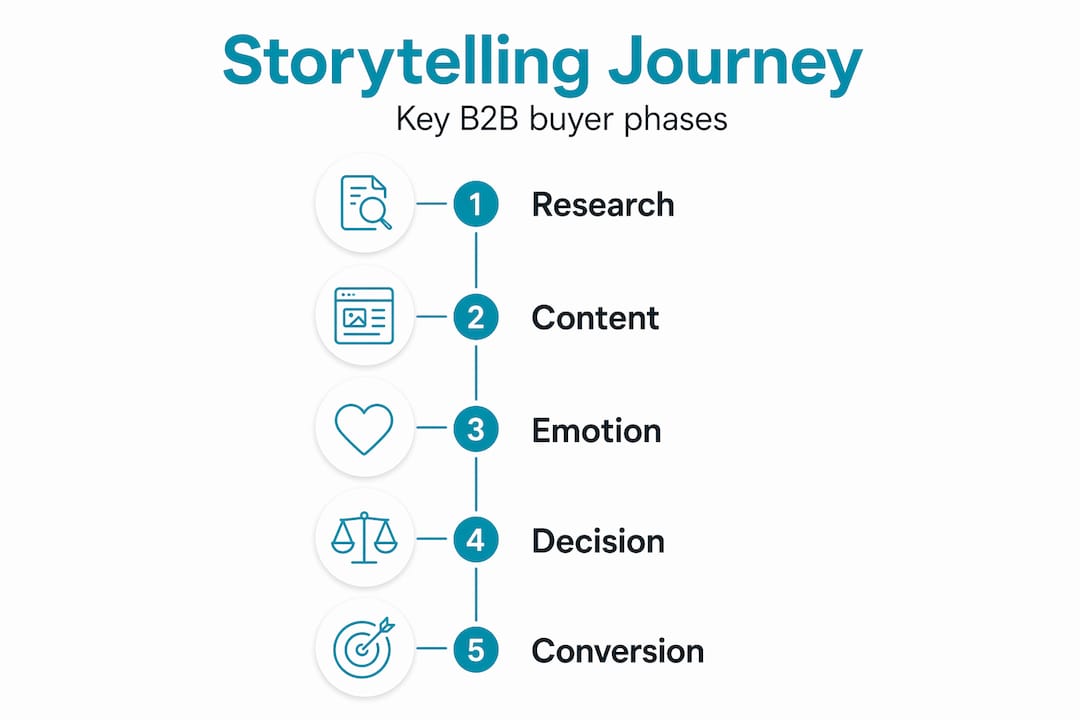
B2B buyers complete 57 to 70% of their purchase research independently, spending only 17% of their total buying time with suppliers. That means the content your buyers consume, without any sales contact, carries enormous weight. If your content is dry, vendor-centric, or purely functional, you lose the opportunity to shape their thinking before the conversation even starts.
What makes content memorable during that independent research phase? Storytelling. Buying groups spend 83% of their time on independent research, and differentiated storytelling directly influences which content they engage with and recall. A well-structured customer story, a clearly articulated problem narrative, or a case study with real stakes will outperform a product comparison sheet every time.
There is a deeper reason this works. B2B buyers are humans first. They feel the pressure of making a wrong call in front of their leadership team. They worry about budget scrutiny, implementation failure, and internal politics. Storytelling that speaks to those emotional realities creates identification. When a buyer reads a story and thinks, “that is exactly my situation,” your brand becomes the obvious solution.
Here is what strong B2B storytelling does during the buyer journey:
- Builds familiarity and trust before any sales interaction
- Creates emotional identification with the buyer’s pain and goals
- Makes your brand memorable across a long, multi-stakeholder buying cycle
- Supports complex decision-making by reducing cognitive load
- Influences content consumption patterns during B2B content consumption stages
Understanding your buyer deeply is the foundation. Developing accurate buyer personas for B2B storytelling helps you map the emotional and rational triggers your narrative needs to address. You can also explore content marketing benefits for SaaS brands to understand how storytelling fits within a broader content framework.
The structural pitfalls of typical B2B storytelling and how to fix them
Most B2B companies do tell stories. The problem is they tell the wrong ones in the wrong way.
The most common failure is placing your company as the hero of the story. “We built this platform, we solved the problem, we delivered results.” That narrative might feel accurate from the inside, but it leaves your buyer cold. They are not looking for a hero to admire. They are looking for someone who understands their situation and can support them through it.
The best B2B stories begin with the buyer’s emotional reality and what is at stake for them, before any resolution is introduced. Think about how that changes the opening of a case study. Instead of “Client X implemented our platform and saw 40% efficiency gains,” try: “The Head of Operations at Client X was three months from a board review, managing a team stretched thin, with a process that was visibly breaking. She needed a fix that would hold up under scrutiny.” That framing creates tension, identification, and interest.
The structural fix is straightforward. Position your brand as the guide, not the hero. Your buyer is the protagonist facing a challenge. You are the experienced ally who helps them navigate it and succeed. This is not just a narrative technique; it directly affects emotional connection in B2B marketing and the trust buyers extend to your brand.
Common storytelling mistakes to eliminate:
- Opening with your company history, mission, or founding story
- Burying the buyer’s problem in favour of your solution features
- Using generic outcomes (“improved efficiency”) without real stakes or context
- Treating case studies as product validation rather than customer narratives
- Ignoring the emotional layer of complex decisions
Look at B2B branding examples that get this right, and you will notice they consistently centre the customer’s world. The power of storytelling to boost engagement is fully realised only when the structure serves the buyer’s journey, not your own.
Pro Tip: Always open your customer stories with the buyer’s emotional reality and the stakes involved before you introduce your product or solution. The tension you create in the first paragraph is what keeps them reading.
Measuring storytelling impact: conversion and pipeline metrics that matter
Storytelling without measurement is just content creation. The goal here is revenue, and the data backs this up clearly.
Top-performing storytelling case studies achieve 4.3% conversion rates, which is 8.6 times the industry average, generate 8.7 times more pipeline influence, and appear in 67% of closed-won deals. For context, generic case studies typically convert below 0.5%. The difference is not production quality or distribution budget. It is the presence of concrete validation signals: named executives, real metrics, and clear stakes.
| Story type | Conversion rate | Pipeline influence | Closed-won presence |
|---|---|---|---|
| Generic case study | Below 0.5% | Low | Occasional |
| Validated storytelling | 4.3% | 8.7x higher | 67% of deals |
Effective storytelling boosts conversion rates by 30% overall, but the ceiling is far higher when you apply a disciplined framework to story construction.
What separates high-converting stories from low-converting ones:
- Named stakeholders with real titles and recognisable company contexts
- Specific, quantified outcomes rather than directional language
- A clear before-and-after structure that mirrors the buyer’s current situation
- Validation signals front-loaded within the first 100 words
- Stories that map directly to active deal stages
This is where storytelling connects directly to B2B demand generation insights. A well-built story is not just a piece of content; it is a demand generation asset that works across the entire funnel, from first awareness to final sign-off.
Pro Tip: Front-load your validation signals. If a story opens with a named executive, a specific company context, and a measurable outcome in the first two sentences, you signal credibility immediately and hold attention far longer.

Aligning storytelling across sales, marketing and customer success
Even the best story fails if different teams are telling different versions of it.
Siloed stories across Sales, Marketing, and Customer Success teams create conflicting narratives that confuse buyers and damage retention. Marketing promises transformation. Sales focuses on features. Customer Success talks about implementation. The buyer experiences three separate conversations about the same product. Trust erodes.
RevOps alignment is the practical fix. When Sales, Marketing, and Customer Success operate from the same narrative framework, every interaction a buyer has with your brand reinforces the same story. The promise made in a content piece is validated by the sales conversation and delivered in onboarding. This continuity builds trust and removes the friction that delays purchase decisions.
Benefits of narrative alignment across teams:
- Buyers receive consistent messaging at every touchpoint
- Sales teams use validated stories as real qualification tools
- Marketing creates assets that sales actually uses, closing the content gap
- Customer success reinforces the value narrative, improving retention
- Forecast accuracy improves because all teams speak the same language
Achieving this requires intentional B2B SaaS customer journey optimisation, mapping each stage to a consistent narrative. When every team knows the story and their role within it, the buyer experience becomes coherent, not fragmented.
How to craft a compelling data-backed B2B storytelling strategy
Strategy without execution is theory. Here is a practical sequence for building a storytelling approach that connects to revenue.
- Define the buyer’s emotional and rational pain. Use customer interviews, sales call recordings, and CRM data to identify the real stakes your buyers face. Not surface-level challenges but the consequences they fear if nothing changes.
- Map your narrative to the buyer’s journey. Different story types serve different stages. Awareness content needs problem-framing narratives. Consideration content needs validated customer stories. Decision content needs specific outcomes with named stakeholders.
- Position your brand as the guide. Every story element should reinforce that the buyer is capable of success and your brand is the experienced partner who helps them get there.
- Align stories with sales forecasting. Data-backed storytelling aligns go-to-market strategy, improving forecast accuracy and the consistency of sales execution across your team.
- Deploy consistently across GTM motions. Ensure the same narrative framework appears in paid media, outbound sequences, sales decks, and customer success communications.
| Approach | Story focus | Outcome |
|---|---|---|
| Traditional B2B content | Product features and company achievements | Low engagement, low conversion |
| Data-backed storytelling | Buyer pain, validated outcomes, named stakeholders | High engagement, measurable pipeline |
The SaaS marketing strategies for ROI that consistently outperform are those built on narrative frameworks grounded in real customer insight. A B2B SaaS content strategy that integrates storytelling at every layer, from demand generation to retention, creates compounding returns over time.
Pro Tip: Track forecast accuracy as a storytelling metric. If deal stages move faster and pipeline confidence improves after introducing aligned narratives, you have direct evidence that your story is working where it matters most.
Why many B2B storytelling efforts fail and how to get it right
Here is the uncomfortable truth we see repeatedly. Most B2B leaders treat storytelling as a branding exercise or a copywriting task. It gets handed to the content team, reviewed for tone of voice, and published. Then everyone wonders why it does not move pipeline.
Many leaders treat storytelling as branding or copywriting rather than as an operating tactic embedded in sales and revenue execution. That misclassification is the root cause of most storytelling failure. When story is separated from sales process, it becomes decorative. It looks good but does not function.
The shift we advocate is treating storytelling as an operating model. Your narrative should be as rigorously maintained as your CRM data. Sales teams should know the core story and be able to deploy it in a discovery call. Marketing should produce assets that map directly to deal stages. Customer Success should reinforce the value narrative in every review. When you build storytelling into your revenue operations, it stops being content and starts being infrastructure.
There is also the question of the importance of storytelling beyond branding. A compelling brand narrative can open doors, but it is the operational consistency of that story across every buyer interaction that closes deals. Brands that get this right do not separate “creative storytelling” from “sales rigour.” They are the same thing, executed together.
The businesses we work with that see the biggest results are those willing to audit every buyer touchpoint and ask: does this reinforce the story, or contradict it? That discipline, applied consistently, is what turns storytelling from a marketing tactic into a genuine revenue asset.
Boost your B2B growth with strategic storytelling solutions
Knowing the theory and executing it consistently are two very different things. At Media House, we work with growth leaders to turn narrative strategy into measurable outcomes, connecting SaaS marketing strategies to boost ROI with story frameworks that actually drive pipeline. Our approach bridges cinematic storytelling with hard data, so every asset you create does a real job. If you are ready to move beyond content for content’s sake, explore how effective brand positioning can sharpen your narrative and differentiate your brand in competitive markets. Start with why the best brands sell stories and build from there.
Frequently asked questions
Why is storytelling important in B2B marketing?
B2B buyers decide emotionally first then justify rationally, so storytelling shapes the emotional layer that drives initial preference, making it essential for building trust and influencing purchase decisions before any sales conversation takes place.
How does storytelling improve B2B conversion rates?
Effective storytelling boosts conversion rates by 30% by making complex information memorable and moving prospects from passive reading to active evaluation of your solution.
What common mistakes do B2B companies make in storytelling?
Most B2B storytelling fails because companies centre themselves as the hero rather than positioning the buyer as the protagonist, which reduces emotional identification and weakens trust throughout the journey.
How can marketing and sales better align their storytelling?
RevOps alignment creates a single, consistent narrative across all teams, ensuring that siloed stories no longer damage retention or confuse buyers at critical touchpoints in the purchase journey.
What role does data play in B2B storytelling?
Data-backed storytelling aligns go-to-market strategy, improving forecast accuracy and sales execution by grounding narratives in evidence, turning compelling stories into credible, repeatable revenue tools.